Minor Arcana · Suit of Swords
Nine of Swords Tarot Card Meaning
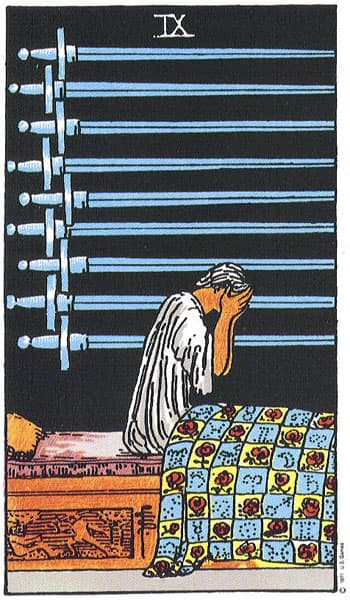
The Nine of Swords depicts a figure in anguish, surrounded by sorrow and mental turmoil. This card invites you to examine the worry consuming your thoughts—often self-created through rumination and fear. It's a mirror to your anxiety, not a prophecy, offering an opportunity to break the cycle of negative thinking and reclaim your mental peace.
Upright
Reversed
↑ Nine of Swords Upright Meaning
When the Nine of Swords appears in your reading, you're being invited to look honestly at the mental suffering you're creating through your own thoughts. In the Rider-Waite-Smith imagery, a figure sits upright in bed, head in hands, while nine swords hang menacingly above. Notice something crucial: the figure is awake, aware, and alone with their thoughts. This card doesn't represent external danger as much as the danger you've constructed in your mind.
The Nine of Swords speaks to that 3 a.m. panic, the catastrophic thinking spiral, the way your mind can convince you that worst-case scenarios are inevitable. This is the card of anxiety that keeps you awake, of replaying conversations obsessively, of imagining problems that haven't happened yet. The swords here are thoughts—sharp, cutting, wounding.
What makes this card so important is what it reveals about your agency. This mental anguish, while very real in its emotional impact, is largely self-perpetuating. You're not trapped by external circumstances as much as you are trapped by your relationship with your own thinking. The invitation here is profound: you have more power over this than you believe.
Spiritual significance lies in understanding this card as a teacher about the power of mind. In many contemplative traditions, the work is precisely this—observing the mind without being controlled by it. The Nine of Swords asks you to develop witness consciousness, to notice the worried thoughts arising without immediately believing they're truth.
Practically, this card often appears when you need permission to pause the mental spinning. It might be calling you toward meditation, therapy, journaling, or simply talking to someone you trust. It's validating your suffering while simultaneously suggesting that relief is possible through shifting your mental patterns. Sometimes it also points to depression or clinical anxiety, which deserves professional support. The card doesn't judge—it witnesses, and it offers hope through awareness.
↓ Nine of Swords Reversed Meaning
Reversed, the Nine of Swords shows the beginning of dawn breaking through the darkness. The mental anguish that was so consuming starts to lift, not because external circumstances changed, but because you've shifted something internally. This might be the moment after therapy when insights click, or when you finally decide to stop catastrophizing.
The reversed position suggests you're starting to see through the fear-based thinking that was holding you captive. Perhaps you've realized that the terrible things you were imagining never actually materialized, or that worrying about them didn't prevent them. This is the card of gradual recovery, of slowly reclaiming your peace of mind.
However, be gentle with this reversal. It doesn't mean the anxiety vanishes overnight. Rather, you're establishing a new relationship with worry. You're learning to question intrusive thoughts instead of automatically believing them. The swords are still present, but they're no longer ruling your emotional landscape.
This reversal can also suggest you're reaching out for help—whether that's therapy, community, or vulnerable conversation with loved ones. The isolation of the upright card is breaking. You're recognizing that suffering alone amplifies suffering, and that connection and support are medicines for an anxious mind.
In some readings, reversed can indicate that you're actually resistant to facing the anxiety you carry, choosing distraction or denial instead. If this resonates, the card is gently pushing you back toward honest self-awareness, which is the first step toward genuine healing.
♥ Nine of Swords in Love & Relationships
Upright, the Nine of Swords in love readings often reflects anxiety about the relationship itself or about being in love. Singles might experience this as fear of rejection, obsessive thinking about whether someone likes them, or catastrophizing about future abandonment. The card can indicate you're sabotaging connection through worry, creating distance through your own mental narrative rather than through any actual problem. In established relationships, it might suggest communication breakdown, unresolved conflicts playing on repeat in your mind, or anxiety about the partnership's stability that isn't grounded in present reality.
This card invites you to ask: Are you creating stories about your partner's feelings or actions? Are you treating worried thoughts as facts? The healing pathway is bringing honest communication into the relationship or, if single, learning to interrupt the anxious thought patterns that prevent you from being present with potential partners.
Reversed, relief emerges. Relationship anxiety begins to ease as communication improves or as you develop better mental boundaries. For those in partnerships, this might indicate resolving a conflict that had been causing mental torment. For singles, reversed suggests you're becoming less anxious about dating, more able to see potential partners clearly without projecting fears onto them. The reversal shows healing through connection, vulnerability, or simply giving yourself permission to relax.
◆ Nine of Swords in Career & Finances
In career readings, the Nine of Swords typically appears when you're caught in work-related worry that's spiraling beyond what the actual situation warrants. You might be replaying a presentation obsessively, imagining job loss that isn't imminent, or creating catastrophic narratives about workplace conflicts. This card is common for people in high-stress environments or those with perfectionist tendencies who punish themselves mentally for any perceived mistake.
Financially, upright often indicates anxiety about money that may not match your actual circumstances—worrying about paying bills while having savings, or obsessing over market conditions you can't control. The card suggests you're suffering mentally far more than necessary.
Reversed brings practical relief. Work stress begins to ease as you complete the project, resolve the conflict, or gain perspective on workplace drama. Financially, reversed suggests moving from anxious money management toward clearer strategy and calm decision-making. You're no longer losing sleep over finances; instead, you're taking concrete actions that reduce actual risk.
✦ Nine of Swords as Feelings
When the Nine of Swords appears in a feelings position, you're looking at someone whose emotional landscape is turbulent and self-directed. Their feelings toward you or the situation are entangled with worry, doubt, and internal conflict. This person may care deeply, but their affection is shadowed by anxiety—they're questioning the relationship's viability, replaying conversations obsessively, or constructing worst-case scenarios. The intensity of their concern can feel suffocating because it's turned inward; they're struggling more with their own fear-based narratives than with you directly. Upright, this suggests their emotional suffering is real but largely self-inflicted, born from overthinking rather than your actions. They may withdraw or seem distant because they're lost in anxious loops. Reversed, the Nine of Swords as feelings suggests this person is beginning to break free from that mental anguish. Their worry is lifting, or they're gaining perspective on catastrophic thinking patterns. They may feel lighter toward you—more hopeful, less trapped by doubt. However, reversed can also indicate they've numbed themselves to feeling entirely, choosing avoidance over confronting difficult emotions. Either way, the reversal points toward movement away from the paralysis of anxiety. In both orientations, this card reveals that their emotional state is more about their internal dialogue than about objective reality. The invitation here is to recognize that their anxious feelings, while valid, may not be an accurate reflection of the situation's truth.
◇ Nine of Swords as How Someone Sees You
The Nine of Swords in a 'how they see you' position reveals that this person perceives you through a lens of worry or concern—and often, they're projecting their own anxiety onto you. Upright, they may see you as a source of their mental anguish, or they view you as someone who is suffering and struggling. You might appear vulnerable, troubled, or caught in a cycle of self-doubt to them. They could also see you as the cause of their sleepless nights, the person who occupies their anxious thoughts. There's a quality of blame or entanglement here; you're woven into their internal distress. Alternatively, they might perceive you as emotionally unavailable or withdrawn—someone whose pain is so consuming that you're unreachable. Reversed, the perception shifts significantly. This person is beginning to see you more clearly, without the filter of their own anxiety. They may recognize you as capable, grounded, or recovering from a difficult period. They could see you as someone who has insight or wisdom about managing mental health. However, reversed can also suggest they see you as emotionally distant, indifferent, or no longer willing to engage in their worry cycles. In both cases, remember that how someone sees you is filtered through their own psychological state. The Nine of Swords suggests their perception is colored by fear-based thinking, not objective observation.
→ Nine of Swords Advice
When the Nine of Swords appears as advice, the guidance is to name and interrupt your thought patterns before they spiral further. You're being invited to recognize the difference between realistic concern and catastrophic imagination. Upright, this card urges you to pause the late-night rumination, the obsessive replaying of events, the mental 'what-ifs' that keep you imprisoned. The advice here is deceptively simple: shine light on the darkness. Write down your worries, speak them aloud to someone trusted, or challenge them logically. What evidence supports this fear? What are you assuming without proof? The card suggests that the mental suffering you're experiencing is real, but its source is internal—which means you have more power to change it than you might feel. Consider whether you're avoiding action by staying trapped in thought. Sometimes the Nine of Swords advises: make a decision, take one small step, or ask for help rather than suffering alone. Reversed, the advice points toward releasing anxiety that no longer serves you. Let go of the worry you've been carrying as if it keeps you safe. The reversal suggests that rumination isn't protecting you; it's paralyzing you. The guidance is to trust yourself, to believe that things may work out despite uncertainty, or to deliberately shift your focus toward what's within your control. Reversed also advises seeking support—therapy, meditation, physical activity—anything that breaks the cycle of anxious thinking. In both orientations, this card asks: what story are you telling yourself, and is it true?
? Nine of Swords: Yes or No?
The Nine of Swords leans toward 'no' in yes/no questions, but with nuance. If you're asking whether something will happen, this card suggests anxiety is clouding your judgment—the answer isn't clear yet because worry is distorting your perception. If asking whether you should proceed with something, the card cautions against acting from a place of fear. However, if asking whether something difficult will pass, the answer is yes—this suffering is temporary. The card asks you to examine the question itself and the fear driving it.
Common Card Combinations
Six of Wands
Success and recognition coming, but anxiety is preventing you from seeing or receiving it. This combination suggests your worries are unfounded—the good things you fear won't happen actually are happening. Your mental suffering is disconnected from reality.
The Hermit
You need solitude and introspection to process the anxiety, but there's a risk of isolation deepening the worry spiral. This combination calls for inner work—meditation, journaling, or therapy—to break the cycle of rumination.
Eight of Cups
Walking away from a situation that's causing significant mental anguish. This combination indicates that sometimes the healthiest response to worry is to leave—the relationship, job, or circumstance is genuinely draining and the anxiety is valid.
The Hanged Man
A shift in perspective is needed to dissolve the anxiety. This combination suggests that looking at the worry from a completely different angle—even turning your thinking upside down—will reveal that the threat isn't real.
Four of Swords
Moving from mental exhaustion toward rest and recovery. This combination indicates that the anxiety is reaching a breaking point and genuine respite is coming—you need and deserve the pause.
The Star
Hope and healing emerging from the darkness of worry. This is a powerfully redemptive combination showing that anxiety is temporary and that renewed faith in yourself and the future is returning.
Knight of Swords
Anxious thoughts becoming more aggressive or chaotic, or conversely, using intellectual clarity to cut through the worry. This combination can indicate either escalating mental turmoil or the beginning of logical analysis that breaks the anxiety cycle.
Frequently Asked Questions
Is the Nine of Swords a bad card?
What does Nine of Swords mean in a love reading?
What does Nine of Swords reversed mean?
Does Nine of Swords mean yes or no?
What does Nine of Swords mean as feelings?
Can Nine of Swords indicate depression?
Ask the AI About Nine of Swords
Get a personalized AI reading and discover how Nine of Swords connects with your unique spread.
Get a Free ReadingTarot readings are for entertainment and self-reflection only. Not a substitute for professional medical, financial, or psychological advice.