Major Arcana · 13
Death Tarot Card Meaning
Death is the Great Transformer of the tarot's Major Arcana. Rather than literal ending, this card invites you to recognize that closure creates space for renewal. Water's flowing energy suggests that what passes away inevitably nourishes what comes next. In readings, Death signals you're in a threshold moment—releasing what no longer serves so authentic change can unfold.
Upright
Reversed
↑ Death Upright Meaning
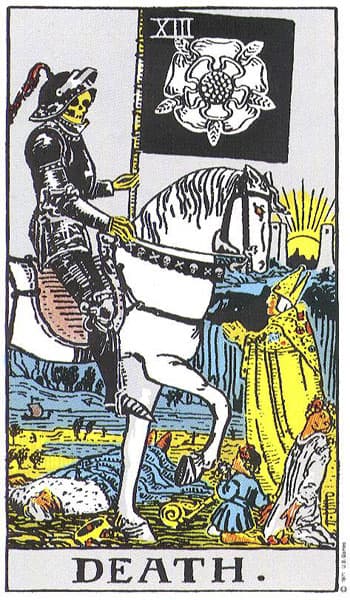
When Death appears upright in your reading, you're standing at a genuine crossroads—not one you can sidestep or negotiate away. The Rider-Waite-Smith image shows a skeletal figure on horseback, moving deliberately through a landscape where a bishop kneels and a child reaches toward the rider's flag. This isn't about morbidity; it's about the skeleton stripped bare, the essential truth that transformation requires vulnerability.
You're being invited to consider what in your life has genuinely completed its cycle. Perhaps it's a relationship that served you once but no longer does. Perhaps it's a belief about yourself that once protected you but now limits you. Perhaps it's a career path, a living situation, or a version of yourself that was necessary then but isn't who you're becoming. The card's water element—Scorpio's domain—suggests this is a deep, soul-level shift, not a surface rearrangement.
The spiritual significance here matters: every tradition recognizes that death and rebirth are paired. The caterpillar doesn't become a butterfly by improving itself incrementally; it dissolves completely in the chrysalis before reorganizing into something entirely new. You're in or approaching that dissolution phase. This can feel frightening—there's genuine loss in every ending. Yet the bishop in the card has surrendered to the inevitable, and the child doesn't flee but watches with open curiosity. Both contain wisdom.
Practically, this card asks you to stop negotiating with what's already finished. When you continue investing energy in something that has completed, you're unavailable for what wants to be born. Death reversed or denied often manifests as depression, repetitive patterns, or a nagging sense of being stuck. Conversely, Death accepted becomes the most liberating card in the deck—because once you release your grip on what was, your hands are finally free to reach toward what's next.
If you're not yet certain what needs to end, this card invites honest self-reflection: Where do you feel trapped? Where are you performing a version of yourself? What have you outgrown? The answers point toward your personal death-and-rebirth work. Trust that discomfort signals readiness for change, not a warning against it.
↓ Death Reversed Meaning
When Death reverses, the transformation stalls. You're either resisting necessary change or caught in an incomplete transition—the chrysalis stage stretching indefinitely without the emergence into what comes next. The reversed card often appears for people who intellectually understand change is necessary but emotionally cannot release the familiar, even when it causes suffering.
This reversal frequently shows up as avoidance disguised as patience. "I'm not ready yet" or "the timing isn't right" can be legitimate wisdom, but reversed Death often indicates you're using these phrases to avoid the discomfort of actual endings. The bishop has stood up and begun walking away from the transition; you've decided the old way is safer than the unknown way.
Reversed Death can also indicate a transition that began but stalled halfway. You've left the old situation but haven't fully stepped into the new identity. Many people live here—divorced but still grieving the marriage, having quit a job but not yet believing in the new one, having ended a friendship but still replaying old conversations. The incompleteness creates a peculiar limbo where you're available to neither the past nor the future.
Psychologically, this reversal sometimes points to fear of your own power. Transformation requires accepting that you're capable of creating radical change in your own life. That's exhilarating and terrifying. Some people would rather suffer in familiar circumstances than claim the agency that real change demands.
In readings, reversed Death suggests gentleness with yourself is needed, but also honest assessment. Is this genuine caution, or is it fear speaking? What small ending could you practice with to build your capacity for larger transitions? The invitation remains the same as upright Death—change is coming whether you cooperate or resist. Cooperation simply makes it less painful and more generative.
♥ Death in Love & Relationships
Upright Death in love readings signals necessary transformation in how you relate. For singles, this often means releasing patterns that haven't served you—whether that's the type of person you've pursued or the version of yourself you've shown in dating. A relationship you've outgrown may be ending to make space for partnership that actually fits who you're becoming. If you're in a relationship, Death suggests the partnership itself is transforming into something new: deeper commitment, a shift in how you show up together, or honest conversations that change the dynamic. This is rarely comfortable, but it's clarifying.
Reversed Death in love indicates resistance to necessary change. You might be holding onto a relationship that's completed its purpose, staying "for the kids" or "until things improve" without real hope of improvement. In new connections, reversed Death suggests you're repeating familiar patterns rather than opening to genuinely different relating. For couples, it can mean avoiding the conversations that would revitalize your partnership. The reversal invites you to ask: What am I afraid will happen if this relationship transforms or ends? The answer usually contains important wisdom about your own growth edges. Sometimes that wisdom says "stay and do the work," but often it says "release with love and make space for evolution."
◆ Death in Career & Finances
In career, upright Death often precedes significant professional transitions. You might be in the final phase of a job, project, or role that's served its purpose. This card appears when you're ready for a new position, industry shift, or complete reinvention of your professional identity. Financially, Death upright suggests completing one financial cycle—paying off debt, ending an investment, closing a business—so new resources can flow in. This card rarely indicates loss; rather, it indicates the end of one financial chapter so the next can begin with fresh possibilities.
Reversed Death in career suggests you're staying in a job that no longer challenges or fulfills you, using stability as an excuse to avoid risk. You might be waiting for "the right time" to job hunt or start that business—but the timing may never feel right. Financially, this reversal often indicates avoiding necessary decisions: not addressing poor spending habits, delaying difficult money conversations, or letting outdated financial structures persist. The reversal asks whether your hesitation is wisdom or whether it's costing you more in stagnation than the discomfort of change would cost. Sometimes staying is right; reversed Death invites clarity about whether you're choosing consciously or defaulting to avoidance.
✦ Death as Feelings
When Death appears as someone's feelings toward you, the energy here suggests a profound shift in how they perceive the dynamic between you—and often, a shift in how they perceive themselves within that dynamic. Upright, this card reveals feelings of necessary release rather than rejection. They may feel drawn to you precisely because you represent transformation, authenticity, or the courage to move beyond old patterns. There's an intensity here: they're experiencing something that demands their full presence, stripping away pretense. If there's romantic potential, they feel the magnetism of genuine encounter—the kind that can't be ignored. However, this card also whispers of bittersweet recognition: they may sense that connection with you will require them to let go of who they've been, and that knowledge creates both attraction and hesitation.
Reversed, Death as feelings often points to emotional stagnation or resistance within them. They may have feelings they're afraid to acknowledge or transform. There's a sense of being stuck—perhaps they're attached to you but unable to move forward, or conversely, they recognize the relationship has run its course but can't bring themselves to accept it. This reversal can indicate avoidance of difficult feelings, clinging to false hope, or denial about what's actually shifting between you. The emotional truth they're trying to suppress tends to be exactly what needs acknowledging. In either position, this card asks you to recognize that their feelings, whatever they are, carry the weight of necessary change.
◇ Death as How Someone Sees You
When Death appears in how someone perceives you, they're seeing you as a catalyst—someone who embodies transition and authenticity. Upright, this person views you as transformative in their world. They may see you as someone who refuses to cling to illusions, who has the courage to move through difficult passages, or who represents a threshold they're both drawn to and afraid of crossing. You appear to them as uncompromising in your authenticity; they recognize something in you that's already shed its false skin. This can manifest as admiration, even awe, but also as caution—they understand intuitively that knowing you or deepening connection will require something of them. If they're considering you romantically, they see you as someone capable of both intimate depth and necessary honesty. You're not safe or predictable; you're real.
Reversed, the perception shifts toward seeing you as stuck, resistant to change, or perhaps as someone who clings to what no longer serves. They may view you as afraid of endings or incapable of moving forward—whether in the relationship itself or in your broader life choices. There's a sense that they see you as avoiding something you need to face. Alternatively, reversed can mean they don't yet recognize your transformative potential; they're perceiving you through an outdated lens. In both positions, this card suggests their perception is tied to where they themselves stand in their own cycles of change.
→ Death Advice
When Death appears as guidance, you're being invited to consider where genuine completion is necessary in your life. Upright, this card offers surprisingly liberating counsel: identify what has truly run its course and grant it permission to end. This isn't recklessness—it's discernment. The advice here is to stop negotiating with what's already dead. Whether it's a relationship dynamic, a career path, a belief about yourself, or a habit of thinking, continuing to pour energy into it delays your metamorphosis. Ask yourself honestly: what am I preserving that's no longer vital? The guidance is to strip away complexity and face what's essential. This might mean a difficult conversation, a formal ending, or simply a mental release. Trust that your authentic next chapter cannot fully emerge until you genuinely let this chapter close. The card also advises vulnerability through the process—don't try to make endings neat or painless. Real transformation is messy.
Reversed, Death suggests the opposite problem: you're stuck in a transition you can't complete. The advice is to stop resisting and start accepting. What are you refusing to let go of? What false hope are you nursing? The card invites you to examine where you're avoiding the natural conclusion of something. Sometimes reversed Death also counsels against premature endings—not every door that closes needs to stay closed forever, but right now, your task is acceptance rather than control. The actionable guidance is to name what you're denying, acknowledge what's shifting whether you like it or not, and take one small step toward acceptance. Whether you're clinging or resisting, the advice remains the same: stop fighting the cycle you're actually in.
✧ What This Card Is Not
The most persistent misreading, fuelled by every horror film that ever cut to this card for a cheap gasp, is that Death predicts physical death. It does not. In over a century of documented tarot practice, readers consistently treat this card as symbolic transition, and it carries no more predictive weight over mortality than the Tower carries over real estate. When it appears, the conversation is about endings of structures, identities, and chapters — not bodies.
A second distortion is treating Death as purely positive spin — the greeting-card version where the card simply means 'exciting new beginnings!' That flattens it. The card insists that something genuinely ends, and that the ending carries real grief. Rebirth language that skips the loss is not reading the card; it is avoiding it. The figure on the card is a skeleton, not a sunrise.
Third, many people read Death as punishment — the universe taking something from them. The card points instead at completion. What ends under Death has usually already ended in every way except your acknowledgment of it. The card arrives late to a funeral you have been refusing to attend.
Finally, reversed Death is not 'change cancelled.' It is change resisted. The river in the image flows regardless of your cooperation. The reversal describes your relationship to a transition already in motion — the clinging, the stalling, the renegotiating — not a stay of execution. The question it raises is never whether the transformation happens, but how much of yourself you spend opposing it.
✧ The Symbolism, Read Closely
Begin with the rider. Pamela Colman Smith gives us a full skeleton in black armour, seated upright on a white horse, facing right — toward the future, in the conventional reading of card direction. The bones are the irreducible thing: everything fleshly, social, and temporary has been stripped away, and what remains still rides. The armour is black not as menace but as inevitability; this figure does not threaten, it simply proceeds. In its left hand it carries a black banner emblazoned with a white five-petalled rose — the mystic rose, a centuries-old emblem of life and spirit, rendered here in white against black so that life literally shines out of the darkness of the flag of endings.
The white horse matters. In older iconography, pale horses signal death itself, but Smith's horse is clean, almost luminous, moving with a deliberate high-stepping gait. It is not rampaging; it is processing. Under its hooves lies a fallen king, crown rolled off his head — the card's quiet argument that death makes no exceptions for status, power, or the identities we have built.
Before the horse stand the three who remain. A bishop or pope figure in golden vestments pleads with hands clasped, as if office or doctrine could negotiate. He cannot. A young woman in pale grey kneels and turns her face away — she cannot stop the arrival either, but her refusal to look is its own kind of honesty. Only the small child in blue faces the rider openly and offers flowers upward. Smith places the smallest, least defended figure closest to acceptance. The hierarchy of responses is deliberate: authority bargains, experience averts its eyes, innocence receives.
The background carries the card's real thesis. On the far horizon, between two towers, a sun rises — Waite himself noted the ambiguity of whether it rises or sets, and that ambiguity is the teaching. A river flows from the distant mountains down through the landscape, bearing a small boat, water being Scorpio's element and the emblem of what dissolves one form so another can take shape. Nothing on the card is on fire. Nothing screams. The sky is grey and calm. Smith drew the least violent image of the most feared card in the deck, and that restraint is the message: this is what ordinary, lawful transformation looks like.
✧ How Other Decks See This Card
In the Tarot de Marseille tradition — the pattern crystallised in decks like the Conver of 1760 — the card is numbered XIII and famously carries no name. The title banner at the bottom is left blank. Readers of the Marseille tradition often point to this silence as deliberate: the one thing that need not be spoken aloud. The image is starkly different from Waite's. There is no horse, no bishop, no child, no sunrise. A standing skeleton with a scythe walks a dark field, harvesting, and the ground around it is scattered with severed hands, feet, and crowned heads — body parts pushing up through soil as if the field is sprouting. The Marseille image is agricultural rather than ceremonial: endings as a harvest that feeds the next planting. The emphasis falls on the cutting itself, not on who witnesses it.
Waite and Smith's 1909 version deliberately softened and ceremonialised the card, swapping the scythe for the banner and populating the scene with the human range of responses to inevitable change. Where the Marseille card shows the blade, the Rider-Waite-Smith shows the procession — the psychology of the ending rather than the act of it.
Crowley and Lady Frieda Harris's Thoth deck, painted in the 1940s, keeps the title Death but transforms the image into something almost ecstatic. Harris painted a dancing skeleton in sweeping motion, wielding the scythe, surrounded by coiling forms — bubbles, a scorpion, a serpent, a fish — visualising Crowley's insistence that death is the complement of life, matter dissolving back into motion so it can re-form. Where Marseille shows the harvest and Rider-Waite-Smith shows the funeral procession, Thoth shows the chemistry: decomposition as the engine of creation.
One historical note on numbering: XIII has been Death's position in the standard trump sequence since the earliest known tarot orders, one of the few cards whose number and place have never seriously shifted across traditions.
✧ What It Looks Like in a Real Reading
Marta has been offered a job in another city — a genuinely good offer — and pulls Death while asking why she can't feel excited about it. She realises, talking it through, that the question was never the job. She has lived in her neighbourhood for eleven years; her whole adult identity is woven into it. The card lands not as an answer about the offer but as permission to grieve the version of her that stays. Once she lets herself mourn the life she would be leaving — the bakery, the neighbours, the woman who learned to be alone there — the decision stops feeling like a threat and starts feeling like a door she can actually walk through, whichever way she chooses.
Devon pulls Death reversed while asking about a friendship. His closest friend moved away two years ago, and their calls have thinned to birthday texts. He tells the reader he's 'just busy,' but the reversal names what he won't: he's been maintaining the friendship as a museum — rereading old messages, refusing to admit the relationship has already changed shape. The card doesn't tell him to end anything. It asks him to stop pretending the old form is still alive, so that whatever the friendship can actually become now — quieter, less central, but real — has room to exist.
Priya's mother has a health scare, and Priya, rattled, pulls Death and nearly closes the app in panic. Sitting with it, she notices the card isn't about her mother's body at all. It's about the role she's been playing: the child who assumes the parents are permanent. The scare has already ended that assumption. The card gives her a way to hold the week — less 'what if' spiralling, more honest appreciation of the shift happening in how she loves her family, gently, and while everyone is still here.
✧ Questions to Sit With
1. What in your life has already ended in every way except your acknowledgment of it — and what would it cost you to say so out loud?
2. Which of the three figures before the horse are you right now: the bishop bargaining, the woman turning away, or the child looking directly at what is coming? What makes that your stance?
3. What identity have you outgrown that you still perform — at work, in your family, online — because retiring it would feel like a small death?
4. Think of a past ending that later revealed itself as a beginning. What did the in-between period actually feel like, and what got you through it?
5. What are you keeping alive with maintenance energy — a project, a dynamic, a version of a relationship — that stopped growing some time ago?
6. If you trusted that releasing one specific thing would free your hands for something not yet visible, what would you put down first?
7. Where in your life are you in the chrysalis — no longer the old thing, not yet the new — and what would it mean to stop rushing or resisting that middle state?
? Death: Yes or No?
In yes-or-no readings, Death's answer depends on your question. If you're asking "Should I end this?" the answer is typically yes—something has genuinely completed. If you're asking "Will this work out as it currently stands?" the answer is no; change is inevitable. If you're asking whether to make a major life shift, Death affirms yes, though the path forward won't be what you expected. Reversed Death suggests not yet—more clarity or readiness is needed before proceeding. The card rarely means an absolute no; it usually means the answer requires you to transform how you're approaching the question itself.
Common Card Combinations
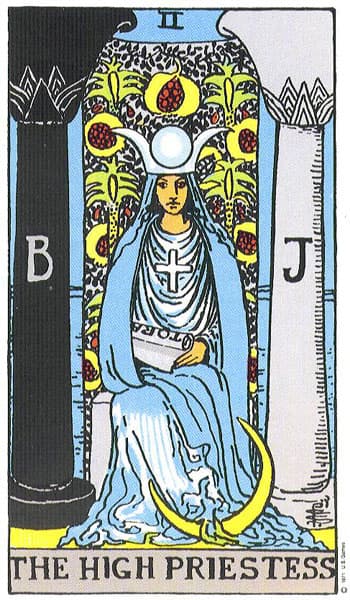
The High Priestess
Death paired with the High Priestess suggests the transformation you're entering contains hidden wisdom or secret knowledge. Trust your intuition during this transition; what you sense beneath the surface is more reliable than what others tell you about this ending.
Seven of Cups
This combination warns that during your transition, illusion or distraction may cloud your clarity. You may be tempted to choose the easy fantasy over the authentic path forward. Stay grounded in what's real, not what's comfortable.
Page of Swords
Death with the Page of Swords indicates you'll need clear communication and honest dialogue as part of this ending. There may be difficult truths to speak or hear, but speaking them creates clean closure rather than unresolved energy.
The Empress
Together, these cards suggest your transformation is leading toward greater creative expression, abundance, or fertility—literal or metaphorical. What's ending makes space for something nurturing and generative to grow.
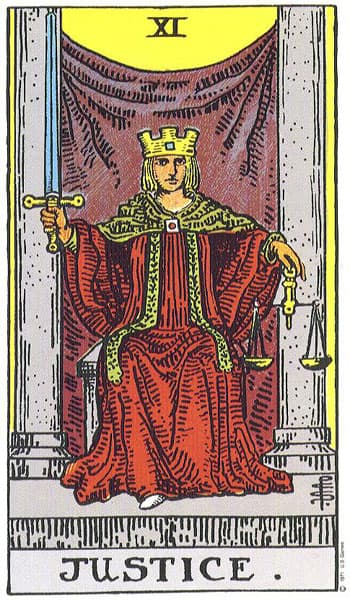
Justice
Death with Justice indicates this ending arrives because of natural consequence or a necessary recalibration of balance. The transformation is fair and aligned with what you've actually earned or created, not arbitrary or unfair.
King of Swords
This pairing suggests clear thinking and mental clarity will guide your transition. You'll benefit from analyzing the situation logically and communicating your boundaries with precision as you navigate this change.
Knight of Pentacles
Death with the Knight of Pentacles indicates slow, steady progress through your transformation. Don't rush the process; trust that practical, grounded steps forward will eventually get you where you need to be.
Frequently Asked Questions
Is Death a good card?
What does Death mean in a love reading?
What does Death reversed mean?
Does Death mean yes or no?
What zodiac sign is Death?
What does Death mean as feelings in a reading?
Does the Death card mean someone is going to die?
What does the Death card mean for reconciliation with an ex?
Why do I keep pulling the Death card in every reading?
What does the Death card mean in a pregnancy or fertility reading?
Is the Death card a bad omen if it appears in the future position?
What does Death mean in a health reading?
What does it mean when Death appears with the Tower in a reading?
What is the spiritual meaning of the Death card?
What does Death reversed mean for moving on from someone?
Ask the AI About Death
Get a personalized AI reading and discover how Death connects with your unique spread.
Get a Free ReadingTarot readings are for entertainment and self-reflection only. Not a substitute for professional medical, financial, or psychological advice.