Minor Arcana · Suit of Swords
Seven of Swords Tarot Card Meaning
The Seven of Swords invites you to examine where deception, strategy, or partial truths may be operating in your life. This card asks whether you're being honest with yourself and others, or if clever maneuvering is masking deeper issues that need direct attention.
Upright
Reversed
↑ Seven of Swords Upright Meaning
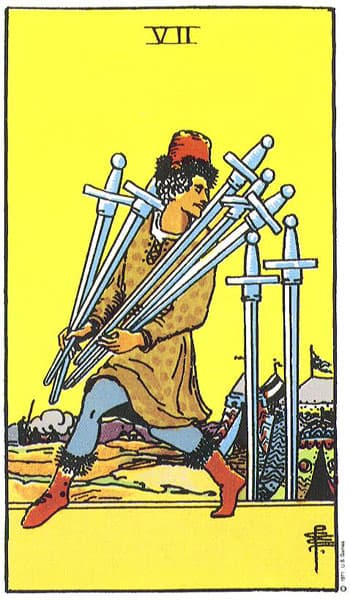
When the Seven of Swords appears in your reading, you're encountering a card that speaks to the complexity of truth and strategy in human experience. The Rider-Waite-Smith imagery shows a figure stealing away with five swords while two remain planted in the ground—a visual reminder that no deception is ever truly complete, and something always remains behind to reveal what happened.
This card doesn't necessarily mean you're a deceitful person. Rather, it invites you to examine where you might be employing selective truths, clever maneuvering, or strategic silence in your life. Perhaps you're telling yourself a partial story about a situation to avoid uncomfortable feelings. Maybe you're withholding information from someone close to you, believing it's for their own good or your own protection. The Seven of Swords asks: What are you not saying? What are you pretending not to know?
The energy here is Air—mental, intellectual, quick-thinking. This is the card of someone who outsmarts rather than confronts, who finds the loophole rather than respects the boundary. In its most neutral form, this represents strategic thinking and clever problem-solving. In its shadow form, it represents the exhaustion that comes from maintaining a false narrative.
Spiritual significance emerges when you recognize that deception creates disconnection—not just with others, but with yourself. The universe, in tarot's wisdom, tends to reveal what's hidden. The Seven of Swords often appears as a wake-up call: the chickens are coming home to roost. What you've swept under the rug will eventually surface.
Practically, this card asks you to consider the long-term cost of short-term gains. If you're currently employing deception or avoidance, what will it cost you when the truth emerges? What relationship trust might be damaged? What internal integrity might be compromised? Conversely, if others are deceiving you, this card validates your intuition that something isn't adding up. Trust what you sense, even if you can't yet prove it.
↓ Seven of Swords Reversed Meaning
The Seven of Swords reversed signals a turning point toward transparency and truth. The swords that were being stolen away are being returned, the mask is slipping, or you're choosing to remove it yourself. This reversal often indicates that deception is no longer sustainable—either you're deciding to come clean, or circumstances are forcing revelations into the light.
When reversed, this card frequently appears for people at a crossroads with honesty. You might be experiencing the relief of finally telling someone the truth you've been carrying, or you might be discovering a deception that has been affecting you. Either way, the energy has shifted from concealment to disclosure.
This reversal can also represent a moment of self-honesty—the internal reckoning where you admit to yourself what you've been avoiding. Perhaps you've been using clever rationalizations to justify behavior that doesn't align with your values. The reversed Seven of Swords asks you to look in the mirror and acknowledge what you see, without the flattering filter.
There's often a moral or karmic dimension to this reversal. Consequences may be arriving, but they also offer an opportunity for genuine change. You're being invited to release the burden of maintaining a false narrative. Interestingly, this can feel both painful and liberating—the discomfort of exposure paired with the freedom of authenticity.
In some contexts, this reversal suggests that a cunning plan is being exposed, or that someone's true intentions are becoming visible. If you've been on the receiving end of deception, this card can indicate that the full picture is finally coming into view. The shadow lifted, you can now see clearly and respond accordingly.
♥ Seven of Swords in Love & Relationships
Upright, the Seven of Swords in love reading often points to a gap between what's being said and what's truly felt. If you're single, this card might suggest you're presenting a version of yourself that isn't entirely authentic—perhaps hiding your true needs or desires to seem more appealing. In a partnership, it frequently indicates one or both partners are holding back truth, whether about small resentments, unmet needs, or more serious betrayals. The card asks: What conversations aren't happening? What do you both know but aren't acknowledging?
Reversed, this card brings relief and recommitment to honesty. For singles, it suggests you're ready to show up more authentically, attracting connections based on who you actually are rather than a curated image. In partnerships, reversal often marks the moment when one partner finally speaks a difficult truth, or when both agree to drop pretenses and address underlying issues. This is the card of couples therapy breakthroughs, of finally saying "I'm not okay," and discovering the relationship can actually handle honesty. The reversal invites deeper intimacy through vulnerability.
◆ Seven of Swords in Career & Finances
Upright in career contexts, the Seven of Swords warns against corner-cutting, resume padding, or taking credit for others' work—all tempting shortcuts that create long-term professional damage. You might be aware of ethical compromises in your workplace, or you might be considering them. Financially, this card cautions against clever schemes or investments that sound too good to be true; they usually are. The energy here is about weighing short-term gain against eventual exposure and loss of trust.
Reversed, this card indicates that deceptive workplace practices are being exposed—perhaps a coworker's dishonesty is revealed, or you're deciding to operate with greater integrity. Financially, reversal suggests coming clean about a mistake, correcting a misunderstanding, or being more transparent with financial advisors and partners. This is the card of reputation recovery through honesty, of admitting you don't know something and asking for help, of building trust through transparency rather than impression management.
✦ Seven of Swords as Feelings
When Seven of Swords appears in the feelings position, you're looking at an emotionally guarded or ambiguous dynamic. The person may harbor mixed feelings—attraction mixed with hesitation, care alongside self-protection. They might feel drawn to you but uncertain about fully committing, keeping emotional options open or holding back their true vulnerability. This card suggests feelings that aren't straightforward; there's a layer of strategic distance, perhaps fear of being fully known. They may admire you while simultaneously protecting themselves from deeper exposure. Reversed, this card shifts toward emotional honesty breaking through. The feelings become clearer, more direct—the person is moving toward transparency after a period of guardedness. Reversed, you might sense them lowering their defenses, becoming more authentic about what they actually feel. However, reversed can also indicate that deceptive feelings are being exposed; what seemed warm may be revealed as self-serving. The key difference: upright is calculated emotional restraint; reversed is either emotional liberation or the unmasking of insincerity. In either position, this card asks you to notice what's being withheld and what remains unspoken. The feelings here have conditions attached—they're not unconditional. Pay attention to what actions or words don't quite match what you're being told. Trust what you observe over reassurances.
◇ Seven of Swords as How Someone Sees You
In the 'how someone sees you' position, Seven of Swords reveals perception tinged with skepticism or caution. This person may see you as clever, perhaps even cunning—someone who knows how to navigate situations strategically. They might admire your resourcefulness while simultaneously questioning your motives. You could be perceived as someone who keeps cards close to the chest, who doesn't reveal everything, who operates with a certain calculated distance. There's an element of intrigue here, but also suspicion. They may wonder what you're not saying, what agenda lies beneath your friendliness. Reversed, the perception shifts toward seeing you as more authentic and direct. They're recognizing sincerity where they once sensed evasion. You're being seen as trustworthy, someone who's dropping the masks. However, reversed can also mean they're finally seeing through a façade—what they once mistook for depth they now recognize as strategy or self-interest. The person sees you as someone operating in gray areas, morally or strategically. In romantic contexts, upright suggests they see you as intriguingly mysterious but potentially untrustworthy. Reversed means they're either appreciating your real self or becoming disillusioned by it. Professional contexts show them viewing you as ambitious and savvy, but perhaps not entirely aligned with collective values. What matters is noticing: are they drawn to the mystery, or does it create distance?
→ Seven of Swords Advice
When Seven of Swords appears as advice, you're being invited to think strategically about what information serves you and what transparency is actually necessary. The card isn't endorsing dishonesty; rather, it's suggesting that you don't need to volunteer every truth, every vulnerability, every thought. There's wisdom in discernment about what to share and with whom. Consider which battles are worth fighting and which are better navigated with a quieter approach. Sometimes the most powerful move is the one nobody sees coming—not through deception, but through thoughtful, intentional action. Examine where you're overexplaining yourself or defending positions that don't require defense. Upright, the advice leans into strategic withdrawal: step back from situations that drain you, remove yourself from dynamics that ask too much, and preserve your energy for what matters. Know when to leave some swords in the ground rather than carrying everything. Reversed, the advice flips toward radical honesty. If you've been holding back, this is your cue to speak your truth, even if it's uncomfortable. Come clean about what's been unspoken. However, reversed also warns against using 'honesty' as a weapon or as performance. True transparency means examining your own motivations without judgment. Ask yourself: Am I being strategic because I'm protecting something real, or am I avoiding accountability? Are my silences wise, or are they enabling harm? The deepest guidance here is this: align your actions with your values, then be honest about the gap between intention and impact.
? Seven of Swords: Yes or No?
The Seven of Swords leans toward "no" in most yes-or-no contexts, particularly if your question involves whether something is genuine, trustworthy, or safe to move forward with. The card's presence suggests hidden factors, incomplete information, or deceptive elements at play. However, if your question is about whether you should be more strategic or protect yourself in a situation, it could offer conditional "maybe"—suggesting careful, thoughtful action rather than naive trust. Always ask yourself: What truth am I not seeing here?
Common Card Combinations
Six of Pentacles
Deceptive generosity or hidden agendas behind apparent kindness—someone may be giving with strings attached, or using gifts to manipulate. This pairing warns to examine motives behind charitable or helpful gestures.
Death
Deception or denial is preventing necessary transformation and closure—you must face what you've been avoiding for real change to occur. This pairing indicates that lies are blocking your evolution.
Knight of Wands
Bold, charming deception or con-artist energy; someone is using charisma and confidence to obscure their true intentions. This pairing suggests careful skepticism toward smooth-talking promises.
Ace of Wands
A deceptive opportunity or clever scheme that appears exciting but requires deeper scrutiny before commitment. This pairing indicates that initial inspiration may be clouding judgment about hidden costs.
Two of Wands
Strategic planning that involves calculated deception or intentional withholding of information to maintain control or advantage. This pairing suggests someone is playing chess with others' emotions or circumstances.
The High Priestess
Secrets being kept intentionally, or intuitive knowledge of deception that you haven't yet consciously acknowledged. This pairing invites you to trust what you sense beneath the surface.
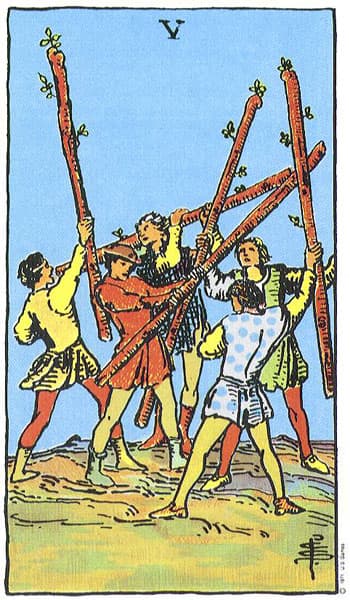
Five of Wands
Conflict arising from hidden agendas and dishonesty finally surfacing—arguments breaking out because the masks have slipped. This pairing indicates that deception has created tension ready to explode.
Frequently Asked Questions
Is the Seven of Swords a bad card?
What does Seven of Swords mean in a love reading?
What does Seven of Swords mean as feelings?
Does Seven of Swords always mean betrayal?
What zodiac sign is Seven of Swords?
How do I know if someone is deceiving me?
Ask the AI About Seven of Swords
Get a personalized AI reading and discover how Seven of Swords connects with your unique spread.
Get a Free ReadingTarot readings are for entertainment and self-reflection only. Not a substitute for professional medical, financial, or psychological advice.