Minor Arcana · Suit of Cups
Six of Cups Tarot Card Meaning
The Six of Cups invites you to reconnect with innocence, joy, and cherished memories. This card speaks to the healing power of nostalgia, inner child reconnection, and genuine emotional exchange. It asks you to revisit what once brought you pure delight and consider how those feelings might guide you today.
Upright
Reversed
↑ Six of Cups Upright Meaning
When the Six of Cups appears upright in your reading, you're being invited into a space of emotional simplicity and authenticity. The card's traditional imagery—two children exchanging flowers in a peaceful garden—speaks to a moment when emotional expression flows freely, unburdened by the defenses we develop as adults.
This card carries the energy of reconnection. You might find yourself drawn to old friendships, childhood haunts, or activities that once brought unfiltered joy. Perhaps you're remembering what it felt like to trust easily, to give without keeping score, or to receive kindness without suspicion. The Six of Cups suggests that revisiting these emotional states isn't escapism—it's essential nourishment.
At a deeper level, this card asks you to examine your relationship with your inner child. That part of you holds wisdom about what genuinely brings you joy, what feels safe, and what your authentic self needs. In a world that constantly asks you to perform, achieve, and prove yourself, the Six of Cups whispers that your value exists simply because you exist. You don't need to earn joy; it's your birthright.
The reversed energy of giving and receiving is particularly significant. Notice whether you're blocking abundance by refusing to accept help or kindness. This card invites a reciprocal flow—you give from a place of genuine warmth, and you receive with gratitude. There's no transaction here, no hidden cost. Emotions move freely.
Practically, this card might indicate a time of healing relationships through vulnerable conversation, rekindling a sense of play in your daily life, or making decisions from your heart rather than your head. If you've been in a pattern of cynicism or emotional guardedness, the Six of Cups suggests that protective walls, while once necessary, may now be limiting your capacity for connection and joy.
↓ Six of Cups Reversed Meaning
The Six of Cups reversed often suggests you're stuck in a loop with the past that no longer serves you. Where the upright card celebrates memory as nourishment, the reversed version warns of nostalgia becoming a prison. You might find yourself repeatedly returning to "better times" while dismissing present opportunities, or romanticizing relationships or situations that actually caused harm.
This reversal can also point to unresolved childhood wounds creating emotional blocks in your present life. Perhaps you struggle to trust others because early experiences taught you that vulnerability isn't safe. Or you may unconsciously recreate childhood dynamics in adult relationships, seeking to finally "get it right" with someone who mirrors an emotionally unavailable parent or sibling.
Emotional immaturity shows up here too—not as innocence, but as an inability or unwillingness to process complex emotions. This might manifest as avoidance of difficult conversations, a tendency to react rather than respond, or difficulty taking responsibility for your emotional impact on others.
There's also a shadow side involving giving and receiving. You might give compulsively to feel worthy, or refuse to accept support because accepting help feels like failure. Alternatively, you could be stuck in a pattern of taking without gratitude, expecting the world to provide without considering reciprocity.
The reversed Six of Cups invites honest inquiry: What about the past are you genuinely grieving versus romanticizing? Which childhood patterns are you ready to release? Where are you refusing to grow because growth feels like betrayal to your younger self? This card reversed is ultimately about recognizing that healing means moving through the past, not camping in it.
♥ Six of Cups in Love & Relationships
In love readings, the upright Six of Cups speaks to emotional openness and genuine connection. For singles, this card suggests that authentic joy—not desperate searching—attracts the right person. You're being called to reconnect with what makes you feel alive; someone who appreciates that energy naturally follows. In established relationships, this card indicates a return to the tenderness and unguarded affection that first drew you together. It's an invitation to play together, to laugh without agenda, to exchange vulnerability freely.
The card also warns against taking your partner for granted. Notice where routine has replaced presence. Can you give and receive love as freely as those children in the garden, without keeping emotional score?
Reversed, the Six of Cups suggests emotional walls in relationships—perhaps stemming from past hurt. You might struggle to trust even when your current partner proves trustworthy, or you unconsciously seek partners who replicate old wounds. In established relationships, this reversal can indicate unresolved resentment creating distance, or one partner emotionally stuck while the other grows. Single people may find themselves romanticizing "the one that got away" rather than being present for new possibilities. Healing here requires acknowledging what the past taught you, grieving what can't be changed, and consciously choosing to meet new people and situations with fresh eyes.
◆ Six of Cups in Career & Finances
Upright, the Six of Cups at work suggests collaboration rooted in genuine goodwill rather than competition. You might be entering a period of mentorship—either receiving guidance from someone experienced or offering your knowledge to someone earlier in their journey. This card favors creative projects, team building, and roles requiring emotional intelligence. There's a lightness here; work feels purposeful rather than purely transactional. In finances, this card indicates generosity flowing both directions—you might receive unexpected help, bonuses, or opportunities. The energy warns against greed; abundance flows when you give freely.
Reversed, the Six of Cups at work indicates feeling emotionally stalled or stuck in outdated patterns. You might be trapped in a role that no longer challenges you, or holding onto resentment toward a manager or colleague. There's a sense of not growing. In teams, this can reflect cliques or favoritism preventing genuine collaboration. Financially, the reversal suggests blocked generosity—either you're afraid to invest in yourself or others, or you've been burned by giving too freely. This card invites honest assessment: Are you staying in a comfort zone disguised as safety? Is nostalgia for "how things were" preventing you from adapting to necessary change?
✦ Six of Cups as Feelings
When the Six of Cups appears as someone's feelings toward you, you're sensing a warmth that carries both tenderness and nostalgia. This person may feel a sense of ease and safety around you—perhaps you remind them of a simpler time, or you evoke genuine, uncomplicated affection. Their feelings have a quality of innocence to them; they're drawn to your authenticity and find joy in your presence without needing pretense. There's a generosity in how they regard you, a willingness to give emotionally without keeping score. This card suggests they see you as someone who brings out their better nature, their more playful and open self. In romantic contexts, this can indicate the early stages of connection where everything feels fresh and promising. Reversed, the Six of Cups as feelings shifts considerably. Here, nostalgia becomes entanglement—they may be stuck comparing you to someone from their past, unable to see you clearly for who you are. Their emotions might feel conditional or performative, offered only when it serves their comfort. There's a potential for emotional immaturity; they may expect you to nurture them without reciprocating. Reversed, this can also suggest they're avoiding genuine emotional connection by romanticizing what could be rather than engaging with what is. The feelings may lack depth, driven more by fantasy than real intimacy. Pay attention to whether their affection allows you to grow, or whether it requires you to stay small and manageable.
◇ Six of Cups as How Someone Sees You
The Six of Cups upright reveals that someone perceives you as a source of emotional refreshment and authenticity. They see you as someone who carries lightness without being superficial—genuinely kind, approachable, and capable of offering comfort without judgment. You may come across as youthful in spirit, not necessarily in age, but in your openness to joy and wonder. They likely attribute a certain generosity to you, sensing that you give emotionally without hidden agendas. If there's a power dynamic at play, you might be seen as the caretaker or the one who initiates connection and nurturing. In professional or platonic contexts, they view you as trustworthy and refreshingly unpretentious. Reversed, the perception shifts toward seeing you through a distorted lens. Someone may view you as naive, easily manipulated, or emotionally available in ways they can exploit. Alternatively, they might see you as stuck in the past—unable to move forward or grow beyond old patterns. You could be perceived as emotionally needy, always seeking comfort or validation like a child seeking a parent's approval. The reversed energy can also suggest they see you as a placeholder for someone else, a stand-in for unresolved feelings rather than a distinct person worthy of genuine regard. There's a sense of you being diminished or not fully seen for your actual complexity and capability.
→ Six of Cups Advice
The Six of Cups upright offers a tender invitation: reconnect with what made you feel alive before you learned to doubt yourself. This might mean revisiting a creative hobby you abandoned, reaching out to an old friend whose company genuinely nourished you, or simply giving yourself permission to be playful and ungarded. The card suggests that emotional healing happens not through forcing yourself to move on, but through honoring what brought you joy. Consider what you were freely giving before you learned to protect your resources. The advice here is to examine where you've become transactional in your relationships and to practice generous emotional expression again—not from obligation, but from genuine abundance. Ask yourself: what would it look like to trust again? What small acts of authentic connection could you offer today? The reversed Six of Cups as advice points toward necessary boundaries and clarity. You're being encouraged to examine whether you're giving from a place of wholeness or from a place of trying to fix someone or recreate a fantasy. Stop romanticizing what's past; engage with what's present. If you find yourself repeating old patterns with people who don't reciprocate genuine care, this card advises you to grow beyond the roles you've outgrown. Release the idea that your value depends on being nurturing or available. The guidance here is to mature emotionally—to develop discernment about where your energy belongs. Ask yourself who truly sees you as an adult and meets you as an equal. Sometimes the most loving thing you can do is stop offering to people who've shown they won't honor the gift.
✧ The Symbolism, Read Closely
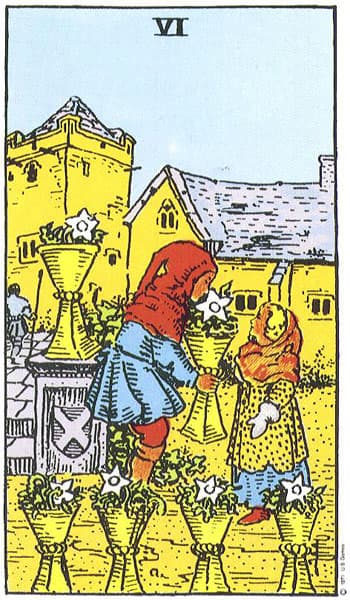
Pamela Colman Smith set this card in a walled village square, and nearly everything she placed in it turns away from the future. The Roman numeral VI sits alone at the top in a pale, cloudless sky — there is no sun, no moon, no weather at all, because this scene does not happen in time the way the other cards do. It happens in memory, which has no weather.
Six golden chalices hold the composition. Four stand in a row along the bottom edge, each planted not with stems but with white five-petalled star-shaped flowers — stars, literally, blooming from cups. The flower of emotion here is not a rose or a lily but something celestial, suggesting that what these cups contain is idealized, lit from above, perhaps more beautiful in recollection than it ever was in fact. A fifth cup stands elevated on a grey stone pedestal to the left, apart from the others, and a small figure in the far left background walks away from it, back turned, heading toward the stairs at the edge of the square. That departing figure is easy to miss and easy to underestimate: someone in this picture is already leaving the garden.
The sixth cup is the one being given. A taller child, hooded in deep red over a blue tunic, leans forward and down, face buried in the blossoms, offering the cup to a smaller child who stands facing them, wrapped in a spotted golden kerchief and a patterned yellow dress. The taller child is smelling the flowers as they give — the gift and the pleasure of the gift are simultaneous, inseparable. The smaller child simply receives, hands near the cup, doing nothing to earn it. The red hood is the card's only saturated warm color; passion and protection are wrapped together in that gesture.
Behind them, the buildings are painted an almost uniform, improbable yellow — houses, tower, and gabled hall all drenched in the same golden wash. This is not architectural realism; it is the color of nostalgia itself, the warm tint the mind lays over places it has left. The tower to the left suggests safety and enclosure; the square is walled; the children are inside. And on the grey pedestal beneath the fifth cup, Smith drew a white shield bearing a plain X — a saltire, a cross, a mark like a signature or a kiss or a crossing-out. It sits at exactly the point where the walking figure departs. Whatever was given here, something was also sealed, marked, finished. The garden holds you warmly, and the card quietly acknowledges the gate.
✧ How Other Decks See This Card
In the Tarot de Marseille tradition, the Six of Cups — Six de Coupe — carries no scene at all. Following the older pip style, it shows six chalices arranged symmetrically among stylized floral scrollwork, typically in the Marseille palette of red, blue, yellow and flesh tones. There are no children, no village, no narrative. Meaning in the Marseille reading tradition grows out of number and suit: six as harmony and exchange, cups as the emotional life. Readers working from that lineage often emphasize balance, reciprocity, and pleasures shared — the card as a state of feeling rather than a memory.
Everything most modern readers associate with this card comes from Pamela Colman Smith's 1909 invention for the Rider-Waite-Smith deck. Arthur Edward Waite gave her comparatively open latitude on the pip cards, and the childhood scene — the gift of a flower-filled cup in a walled square — was her contribution, not a recovery of older imagery. Waite's own written meanings leaned toward the past, remembrance, and things that have vanished, and Smith's picture made that abstraction visible. The nostalgia reading is, in other words, a twentieth-century interpretation that became so vivid it now feels ancient.
Crowley and Lady Frieda Harris took the card somewhere else entirely. In the Thoth deck, the Six of Cups is titled Pleasure. Six cups stand in two rows against a glowing background, water flowing between them, with a solar quality radiating through the whole design — Crowley placed this card at the Sun in Scorpio, an astrological attribution from the Golden Dawn system that underlies both decks. Where Smith's card looks backward with tenderness, the Thoth card is emphatically present-tense: pleasure as a full, flowing, even erotic emotional abundance. Read the three traditions together and the card's range appears: the Marseille six as emotional harmony in general, Smith's version as feeling filtered through memory, and the Thoth as feeling at its sensual peak. One card, three temperatures of water.
✧ What It Looks Like in a Real Reading
Marta asks about a job offer at a large firm — better pay, longer hours — while her old employer, a small studio where she felt genuinely liked, has hinted she could return. She pulls the Six of Cups. The card doesn't answer the salary question; it reframes it. What she remembers about the studio isn't the work but the feeling of being known there, of Friday afternoons and unguarded laughter. The card invites her to ask whether that warmth is something she can only recover by going back, or something she's allowed to build again somewhere new. She notices, too, that her memory of the studio has quietly edited out the reasons she left.
Devon's sister texts after two years of silence, a short message about their mother's house being sold. He asks the cards what this contact means for him and pulls the Six of Cups. It lands as both balm and caution. The card reflects the real tenderness underneath the estrangement — shared childhood, shared loss — and it also names the risk: sliding straight back into his old role as the agreeable younger brother, mistaking familiarity for resolution. The card invites him to receive the message warmly while staying the adult he has become, rather than the boy the family script once assigned him.
Priya, waiting on follow-up medical results that are likely routine, asks how to get through the week without spiraling. The Six of Cups appears. For her it points somewhere unexpected: toward the self-soothing she knew before adulthood taught her to brace. She remembers being small and unafraid in her grandmother's kitchen, the radio on, soup simmering. The card suggests she can deliberately borrow that atmosphere now — cook the soup, call the cousin who makes her laugh — not as denial of the worry but as a way of keeping her nervous system in the present, where she is, as of today, okay.
✧ Questions to Sit With
1. What is one thing you loved doing before anyone told you whether you were good at it — and what, exactly, stopped you?
2. When you picture a place from your past as golden and safe, what are you choosing not to remember about it? Write the edited-out paragraph.
3. Who in your life do you give to freely, without keeping score — and with whom are you still counting? What does the counting protect?
4. When someone offers you help or kindness, what is your first physical reaction? Where did you learn that reaction?
5. If the figure walking out of the walled square in this card is a part of you, what is it walking toward?
6. Which childhood role — the responsible one, the clown, the quiet one — are you still performing for people who no longer need it?
7. What would receiving without apology look like this week? Name one specific offer you could simply say yes to.
? Six of Cups: Yes or No?
The upright Six of Cups leans toward "yes," particularly if your question involves reconnection, reconciliation, or choosing the emotionally authentic path. The card's energy supports decisions rooted in genuine feeling and joy. However, this is a gentle "yes"—not a forceful one. It suggests moving forward with openness rather than certainty.
Reversed, the answer becomes "maybe" or "not yet." If you're asking whether to reconnect with someone from your past, the reversal warns that you may not be ready—unresolved emotions could cloud judgment. If asking whether to take an opportunity, the card suggests examining whether you're choosing from authentic desire or fear of the unknown.
Common Card Combinations
Ace of Wands
New creative passion rekindled through reconnection with your authentic self and joy. You're about to pursue something you loved as a child or with the enthusiasm of your younger self.
Temperance
Balanced integration of past and present; nostalgia is informing healthy choices rather than controlling them. You're honoring what came before while moving forward with wisdom and moderation.
Ten of Cups
Emotional harmony within family or chosen family; cycles of love and generosity creating lasting happiness. Past connections are being healed and transformed into deep fulfillment.
Three of Cups
Celebration with trusted friends or community; reconnecting with people who see and accept your true self. Shared joy and vulnerability deepening existing bonds or forming new ones.
Five of Pentacles
Emotional or material hardship stemming from holding onto the past or unresolved childhood poverty consciousness. Healing requires releasing what no longer feeds you.
The Sun
Pure joy and clarity emerging from reconnecting with your inner light and authentic happiness. Nostalgia serves as a bridge to renewed hope and vitality.
Nine of Cups
Wish fulfillment through emotional honesty and alignment with what truly makes you happy. You're finally allowing yourself the joy and contentment you deserve.
Frequently Asked Questions
Is the Six of Cups a good card in a tarot reading?
What does the Six of Cups mean in a love reading?
What does the Six of Cups reversed mean?
Does the Six of Cups mean I should reconnect with an ex?
What zodiac sign corresponds to the Six of Cups?
What does the Six of Cups mean as feelings?
What does the Six of Cups mean when it comes up about childhood?
Is the Six of Cups a yes or no card?
What does the Six of Cups mean for friendship?
Why do I keep pulling the Six of Cups in every reading?
What does the Six of Cups mean as a person or personality?
Does the Six of Cups mean someone from my past is coming back?
What does the Six of Cups mean in a reconciliation reading?
What does the Six of Cups mean for pregnancy or family questions?
How is the Six of Cups different from the Ten of Cups?
Ask the AI About Six of Cups
Get a personalized AI reading and discover how Six of Cups connects with your unique spread.
Get a Free ReadingTarot readings are for entertainment and self-reflection only. Not a substitute for professional medical, financial, or psychological advice.