Minor Arcana · Suit of Swords
Ten of Swords Tarot Card Meaning
The Ten of Swords depicts a moment of profound clarity born from painful endings. This card invites you to recognize that the worst has passed, and what feels like devastation is actually the breaking point that precedes transformation and renewal.
Upright
Reversed
↑ Ten of Swords Upright Meaning
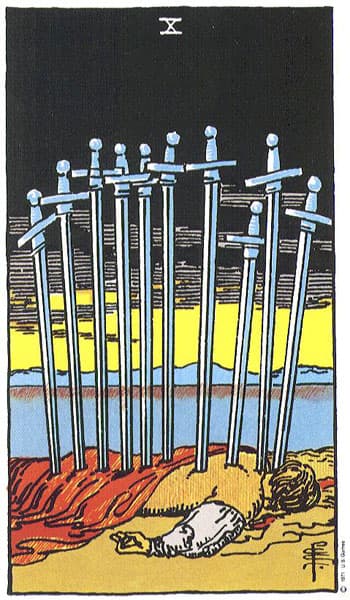
When the Ten of Swords appears upright in your reading, you're being invited to witness a threshold moment—one where the accumulation of pain, betrayal, or loss has reached its inevitable conclusion. The Rider-Waite-Smith image shows a figure pierced by ten swords, lying face-down under a dark sky. Rather than depicting ongoing suffering, this card speaks to the finality of a difficult cycle.
This energy suggests you've reached a point of absolute clarity, even if it doesn't feel that way. The ten swords represent the exhaustion of every possible avenue of denial. You can no longer pretend, negotiate, or hope things will magically improve. A relationship has truly ended. A dream has genuinely died. A truth you've been avoiding has become impossible to ignore.
The spiritual significance here is often misunderstood. Yes, this card carries weight and sorrow. But it also carries release. Imagine carrying ten heavy burdens—the moment they all fall away at once, you finally feel the ground beneath your feet. The Ten of Swords is that moment of surrender, where resistance becomes futile and surrender becomes your greatest wisdom.
Practically speaking, this card invites you to stop fighting what has already been decided by circumstance. It asks you to acknowledge your grief fully rather than compartmentalize it. Crying, journaling, speaking with a trusted person—these are the actions this card supports. You're not being asked to "be strong" or "look on the bright side." You're being asked to feel the full weight of what is, so you can eventually move through it.
The dark sky in the card's imagery will eventually shift to dawn. But you're not there yet. Right now, you're in the honest darkness of acknowledgment. This is actually a place of power, though it doesn't feel that way. From here, and only from here, genuine healing can begin.
↓ Ten of Swords Reversed Meaning
The Ten of Swords reversed signals an important shift: you're beginning to wake from the nightmare. Where the upright card shows you in the depths, the reversed card shows you stirring, becoming aware that the worst has indeed passed.
This reversal often appears when you're moving from victimhood into agency. You might catch yourself replaying the painful story for the hundredth time and realize you're choosing to relive it. You notice a day went by where you didn't think about the loss. You laugh at something and realize grief isn't the only thing you feel anymore.
Reversed, the Ten of Swords invites you to examine where you might still be clinging to the narrative of being wronged or destroyed. This isn't about denying real harm—it's about recognizing that you've survived it. The energy here suggests you're ready to set down the heavy stones you've been carrying and ask yourself: What becomes possible now?
This can also indicate forgiveness emerging, not for the sake of the person who hurt you, but for yourself. You're beginning to see that holding onto resentment only keeps you pierced by those swords. Letting go becomes an act of self-love rather than weakness.
Practically, reversed energy suggests it's time to redirect your energy toward rebuilding. Start small—invest in things that feel nourishing, reach out to people who uplift you, begin envisioning what comes next. The storm is clearing. You're not yet in full sunlight, but you can sense it coming.
♥ Ten of Swords in Love & Relationships
Upright, the Ten of Swords in love readings often signals a relationship has reached its breaking point. For those in partnerships, this card suggests you've finally seen the truth you've been avoiding—whether that's repeated betrayal, fundamental incompatibility, or simply two people who have grown in different directions. The pain here is real, but so is the clarity. This card invites you to honor what once was while acknowledging it cannot continue as it has been.
For singles, this card sometimes appears after a painful ending, suggesting you're in the raw space of grief. The invitation is to feel it fully rather than rush toward the next connection. You're learning something essential about yourself through this loss.
Reversed in love readings, the Ten of Swords brings hope. If you've been separated, you might be ready to genuinely move forward rather than staying stuck. In existing relationships, reversal can indicate you're working through conflict and finding your way back to each other—or choosing to part with grace rather than bitterness. The key shift is from "this will destroy me" to "I will survive and grow from this." Forgiveness, either of your partner or yourself, becomes possible. You're remembering why you chose this person, or you're finally accepting it's time to choose yourself.
◆ Ten of Swords in Career & Finances
In career contexts, the Ten of Swords upright often appears when a job has become genuinely untenable. You've exhausted every option—you've tried to improve communication, adjusted your expectations, transferred departments, or given it more time. Now the only honest choice is to leave. This card validates that it's time to move on, even if the transition will be difficult.
Financially, this card can signal a significant loss or the culmination of poor financial decisions catching up with you. Rather than continue avoiding the truth, this is an invitation to face the numbers, create a plan, and begin rebuilding. The pain is real, but so is the clarity about what needs to change.
Reversed, the Ten of Swords in career readings suggests you're beginning to recover from burnout or job loss. You're seeing glimmers of new opportunity or feeling your energy return. In finances, reversal indicates you're gaining perspective on past mistakes and implementing real changes. A bankruptcy can be finalized. A difficult career transition is completing. You're moving from the reactive crisis phase into the proactive planning phase. This is when you begin networking, updating your resume, or creating a realistic financial recovery plan.
✦ Ten of Swords as Feelings
When Ten of Swords appears in the feelings position, you're encountering someone's emotional exhaustion—a state of depletion that has moved beyond active pain into resignation. This person may feel you represent the final straw in a series of disappointments, or they're experiencing such deep wounding around the situation that they've emotionally withdrawn. The feeling here isn't anger so much as a kind of numb acceptance that things have ended. They may be processing betrayal, unmet expectations, or a realization that staying connected costs too much. Upright, this suggests their feelings toward you carry weight and finality—they've made a decision, even if it's still fresh. There's clarity in their emotional landscape, but it's the clarity of someone who has stopped hoping for different. Reversed, Ten of Swords as feelings indicates they're beginning to emerge from this emotional rock bottom. They may be reconsidering whether the ending was truly necessary, or they're starting to feel relief wash over them as they accept what happened. The reversed energy suggests their feelings are shifting from paralysis to tentative healing. Perhaps they're starting to see you differently—not as the source of their pain, but as a mirror to their own growth. Either way, this card reveals deep emotional processing happening beneath the surface.
◇ Ten of Swords as How Someone Sees You
In the 'how someone sees you' position, Ten of Swords suggests this person perceives you as connected to their pain—either as its source or as a symbol of a difficult chapter they're closing. They may see you as someone who has wounded them, intentionally or otherwise, and they're viewing you through the lens of that injury. Upright, you might appear as the unavoidable truth they've been avoiding, the person whose presence or actions forced them to confront something they didn't want to face. They could see you as someone bound to a painful narrative, even if that's not your intention. This isn't necessarily about blame; it's about association with loss. Reversed, their perception begins to shift. They may start seeing you as someone caught in the same difficult cycle they are, worthy of compassion rather than resentment. They might recognize you as a catalyst for necessary change rather than as the villain. The reversed perspective allows them to separate you from the pain and see your actual qualities—your humanity, your own struggles. Over time, they could come to see you as part of their evolution, someone who helped them reach a necessary ending so something new could begin.
→ Ten of Swords Advice
When Ten of Swords appears as advice, it invites you to stop resisting what you already know in your bones. The guidance here is about surrender—not defeat, but honest acknowledgment. If you're in a situation that keeps wounding you, this card suggests the time for half-measures has passed. You're being invited to name what's actually happening, to stop softening the truth with hope, and to make a clear-eyed decision about what comes next. Upright Ten of Swords advises you to pass through the threshold rather than camp at it. Face what's ending. Grieve it fully. Then begin the work of moving beyond it. This is the card that says: stop trying to fix what was broken in its foundation. Release the narrative where you could have done more, been more, prevented this. Rock bottom offers strange clarity—use it. Reversed, Ten of Swords suggests you're at the turning point: the worst has already happened, and from here, you rebuild. The advice shifts toward self-compassion and gentle forward movement. You've survived the fall; now tend to yourself with patience. This reversal also warns against prolonging suffering unnecessarily. If you've already learned the lesson, don't stay in the discomfort for penance. The advice is to recognize when healing has begun and actively step into it, even when grief is still present.
✧ The Symbolism, Read Closely
Look at what Pamela Colman Smith actually put on this card, because every element earns its place. The composition is brutally horizontal: a man lies face-down on bare yellow earth, his body stretched across the lower third of the frame, and ten swords stand planted along the length of his back, their points driven into him and their hilts rising like a fence against the sky. Count them — ten, the full measure of the suit, no sword withheld. The mind (Air, the suit's element) has carried this conflict to its absolute terminus.
Notice the man's right hand. It is not clenched in agony or raised in supplication. It forms the same two-fingered gesture of blessing that the Hierophant makes in the Major Arcana — and this is one of the most debated details in the whole deck. Waite and Smith placed it there deliberately: even at the moment of utter defeat, some dignity or meaning is being conferred. The ruin is not meaningless. His red cloak pools beneath him, the colour of life and passion drained out onto the ground, while his white undergarment suggests something underneath the drama that was always simple, always exposed.
Now read the background in layers, because Smith built it as a timeline. The upper half of the card is a solid, opaque black sky — total darkness, no stars, no moon. But at the horizon, a clean band of brilliant yellow light breaks across the water. Dawn exists in this picture. It simply has not reached the figure yet. Below the yellow sits calm, flat blue water — utterly still, no waves, no storm. The element of feeling has already quieted itself; only the mind's sky is still dark. That gap between the calm water and the black sky is the whole psychology of the card: the situation itself has ended, but the thinking about it continues to wound.
The ground is ochre and barren, no vegetation, no shelter — an emptied stage. And in the far right edge, tiny hills rise where the darkness ends. Smith gave you the exit and hid it at the margin, where a despairing eye would never look. The ten swords, meanwhile, are evenly spaced, almost ceremonial — as if the catastrophe has a strange order to it, a completion rather than a chaos.
✧ What This Card Is Not
The most common distortion is treating the Ten of Swords as a death card. It is not Death — that card exists separately, and it shows a figure on horseback moving forward. The Ten of Swords shows an ending that has already fully happened. Nothing on this card is in motion. If you pull it, it is not warning you of catastrophe to come; it is acknowledging catastrophe that is finished. The swords are planted, not falling.
Second misreading: that this card means things will get worse. Pop culture loves it as a harbinger of doom, but look at the image — this is rock bottom, which means there is no further down available within this cycle. Ten is completion. The suit cannot wound you an eleventh time. What the card actually points at is the strange, flat calm that follows a total ending, and the fact that you are still breathing inside it.
Third: that the card accuses you of being a victim of others' malice. Sometimes the ten swords are betrayal. But readers often find they are also self-inflicted — the relentless inner critic, the catastrophizing mind, the story rehearsed until it became true. The suit is Air. These are thoughts before they are daggers.
Finally, this card is not an instruction to wallow. The black sky occupies half the image, but the yellow dawn band and the still water occupy the rest. The card never asks you to stay in the figure's posture. It asks you to notice that the hand is already forming a blessing, that the water is already calm, and that the sky is only dark above, not everywhere.
✧ Reading the Reversal by Position
A reversed Ten of Swords does not mean one thing — it means different things depending on where it lands in your spread.
In the past position, it usually reads as a wound you have genuinely survived but not fully metabolised. The swords came out, but you still flinch when someone reaches toward your back. The invitation here is to ask whether you're making present decisions in service of an old ending.
In the present position, reversed often signals the moment of stirring — you are in the recovery right now, and it may not feel like recovery. Readers often find this position describes someone who feels guilty for starting to feel better, or who keeps checking the wound to confirm it still hurts. The card gently suggests the checking itself is the last sword.
In the future or outcome position, reversal points toward closure arriving, but on the condition that you stop re-entering the story. It suggests the worst of the cycle resolves — not through vindication, but through your own releasing of it.
As an obstacle, the reversed card frequently marks an attachment to the identity of the wounded one. The pain has become proof of something — that you were right, that you were wronged, that you mattered. The block is not the pain; it's what the pain has come to mean.
As advice, reversal is blunt: begin the healing on purpose. Forgive for your own sake. Take the swords out one at a time rather than waiting for them to dissolve.
To tell an internalised reversal from a blocked one: the internalised version feels like grief turned inward — self-blame, depression of spirit, the swords pointed at yourself. The blocked version feels like refusal — you know the healing is available and something in you declines it. Internalised reversal calls for tenderness. Blocked reversal calls for honesty.
✧ What It Looks Like in a Real Reading
Marta had been freelancing for a client for three years, and the work had been shrinking for months — invoices paid late, briefs going to someone cheaper, silence where there used to be collaboration. She asked the cards whether she should pitch the client on a renewed contract. The Ten of Swords arrived. In the reading, it landed not as a warning but as a mirror: the relationship had already ended; she just hadn't stopped showing up to it. The card invited her to spend her energy on new clients rather than resuscitating this one, and to let herself actually grieve a partnership she had liked. The clarity stung. It also freed up her Tuesdays.
Devon's brother had texted him a short, cold message after a family argument — three words, then nothing for six weeks. Devon pulled the Ten of Swords asking what was happening between them. Rather than confirming the relationship was destroyed, the card reflected Devon's own posture: he had been lying face-down in the worst interpretation, composing funerals for a bond that had suffered a wound but not necessarily ten of them. The reading turned on a single question: are you responding to what your brother did, or to the story you've built on top of it? The card asked him to separate the swords that were real from the ones he'd been adding himself.
Priya was waiting on follow-up results after a routine screening flagged something her doctor called "probably nothing, but let's check." Unable to sleep, she asked the cards how to hold the uncertainty, and drew the Ten of Swords. The card didn't speak to the medical question at all — it spoke to her mind, which had already run every catastrophic ending to completion. The reading invited her to notice that the sky in her head was black while the facts on the ground were still unknown. Her task for the week wasn't to predict; it was to stop lying in a future that hadn't arrived.
? Ten of Swords: Yes or No?
The answer is fundamentally **No**—but with important nuance. The Ten of Swords suggests that what you're asking about has already reached its conclusion. If you're asking whether something will work out as you hope, this card indicates it won't. If you're asking whether you should continue pursuing something, the answer is to let it go. However, if your question involves whether you can survive what's happening or whether healing is possible, the answer becomes a grounded **Yes**. This card acknowledges endings, not as failure, but as the necessary clearing of ground for what comes next.
Common Card Combinations
Knight of Pentacles
After devastation, practical grounding and slow, methodical rebuilding become possible. This pairing suggests you're moving from crisis into recovery mode, taking concrete steps to stabilize your foundation.
The Magician
Your pain has taught you resourcefulness and clarity about what you truly need. This combination indicates you're ready to take conscious action and remake your circumstances with newfound wisdom and power.
Four of Wands
Celebration and joy emerge after the darkest moment. This pairing suggests that what felt like permanent damage will transform into gratitude and reunion—either with yourself, a community, or a renewed sense of home.
The Empress
Nurturing and creative renewal follow the ending. This pairing invites you to channel your pain into generosity toward yourself and others, allowing new growth to flourish from the cleared ground.
Strength
Inner resilience and compassion emerge from your trials. This combination reveals that your greatest strength has been forged through endurance and that you now possess the fortitude to move forward with grace.
Ace of Cups
New emotional beginning or spiritual awakening follows the ending. This pairing suggests that after the pain clears, you'll receive or open to a powerful influx of love, healing, or creative inspiration.
Three of Cups
Community and celebration become your medicine. This combination indicates that support from friends and shared joy help you process the loss and find renewed belonging after the isolation of pain.
Frequently Asked Questions
Is the Ten of Swords a bad card?
What does Ten of Swords mean as feelings?
Can Ten of Swords mean yes or no?
What zodiac sign is Ten of Swords?
Is Ten of Swords always about death or endings?
What does Ten of Swords mean in a love reading?
Does the Ten of Swords mean my relationship is over?
What does the Ten of Swords mean when it comes up about an ex?
Why do I keep pulling the Ten of Swords over and over?
Is the Ten of Swords worse than the Tower?
What does the Ten of Swords mean for reconciliation?
What does the Ten of Swords mean about someone's intentions?
Can the Ten of Swords be a positive card?
What does the Ten of Swords mean spiritually?
What should I do if the Ten of Swords is my outcome card?
Ask the AI About Ten of Swords
Get a personalized AI reading and discover how Ten of Swords connects with your unique spread.
Get a Free ReadingTarot readings are for entertainment and self-reflection only. Not a substitute for professional medical, financial, or psychological advice.