Major Arcana · 18
The Moon Tarot Card Meaning
The Moon is a card of illusion, intuition, and the subconscious mind. It invites you to question what you perceive, trust your inner wisdom, and navigate the uncertainty between reality and fear. This water card asks: what are you afraid to see clearly?
Upright
Reversed
↑ The Moon Upright Meaning
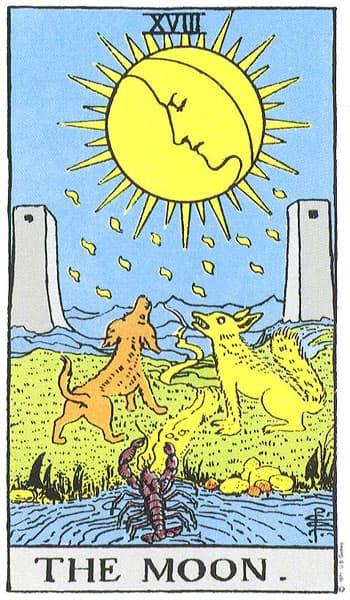
When The Moon appears in your reading, you're being invited into a conversation with your own shadow—the parts of yourself and your situation that remain unclear, hidden, or frightening. The imagery of the Rider-Waite-Smith deck shows two towers flanking a path, a dog and wolf howling at the moon, and a lobster emerging from water. This composition tells a story: you're at a threshold between the conscious world and the realm of dreams, instinct, and emotion.
This card doesn't mean something bad is happening. Rather, it suggests you're in a season where clarity is obscured—not necessarily by external forces, but by your own inner state. Fear, anxiety, and uncertainty are creating a fog through which you're trying to navigate. The energy here invites you to recognize that some of what you're perceiving may be filtered through anxiety rather than objective truth.
The Moon is deeply connected to your intuition and subconscious mind. While it can feel destabilizing, this card often appears when your psyche is trying to communicate something important. Dreams, hunches, emotional responses—these are the language The Moon speaks. You might notice patterns repeating, symbols appearing in unexpected places, or a persistent sense that something is "off" even if you can't articulate why.
The card also speaks to the theme of illusion. Not necessarily lies, but the gap between appearance and reality. In relationships, this might mean assumptions you're making about someone's feelings. In work, it could be confusion about a project's true status. In personal development, it's the stories you tell yourself that may or may not be serving you.
Spiritual significance here centers on trust—not blind faith, but trust in your ability to navigate mystery. The lobster emerging from the water symbolizes emerging slowly from the unconscious into awareness. Your work isn't to force clarity immediately, but to develop comfort with the in-between space, the liminal zone where transformation happens.
Practically, The Moon asks you to slow down. Journal about your fears and dreams. Notice what your body is telling you. Spend time alone to process. Seek second opinions, not because you can't trust yourself, but because another perspective can pierce the fog. This is a time to be gentle with yourself and to recognize that some confusion is actually appropriate—you genuinely don't have all the information yet, and that's okay.
↓ The Moon Reversed Meaning
When The Moon reverses, the fog begins to lift. This is the card of clarity breaking through confusion, of secrets being revealed, and of anxiety loosening its grip. You're emerging from a period of uncertainty into a space where you can see more clearly—both externally and within yourself.
Reversed, The Moon often indicates that the illusions maintaining you have begun to dissolve. If you've been operating under false assumptions about a situation or person, truth is surfacing. If you've been caught in anxiety loops, you're developing the mental clarity to question those patterns. This isn't always comfortable—sometimes ignorance feels safer than truth—but it's a necessary movement toward authenticity.
This reversal also suggests you're developing stronger discernment. You're learning to distinguish between intuition (which is often quiet and persistent) and fear (which is loud and urgent). The reversed Moon indicates you're trusting your instincts more deeply, not because they're perfect, but because you're learning to listen to them accurately.
In psychological terms, reversed Moon energy represents the integration of shadow material. What was unconscious is becoming conscious. What was mysterious is becoming understandable. You might find yourself having sudden insights or "aha moments" where patterns you couldn't see before suddenly make sense.
This card can also point to moving past deception—either your own self-deception or someone else's manipulation. If you've felt gaslit or confused in a relationship or situation, the reversed Moon suggests you're reclaiming your sense of reality and your trust in your own perception.
Practically, this is a time to act on the clarity you're gaining. If you've been stalled by confusion or fear, reversed Moon energy supports taking steps forward. Trust the insights emerging. Test your new understanding. Move gradually toward situations you've been avoiding.
♥ The Moon in Love & Relationships
Upright Moon energy in love readings often points to uncertainty or unspoken feelings. If you're single, this card can indicate you're unsure about someone's true feelings, or you're projecting fears onto potential connections. There may be chemistry that confuses you, or you're processing old relationship patterns that cloud your judgment about new people. The card invites you to slow down, notice what you're actually feeling versus what you're afraid of feeling, and give situations time to become clearer.
In established relationships, upright Moon suggests emotional distance or unspoken concerns. You might sense your partner is holding something back, or you're struggling to communicate something important. This is often a sign to have vulnerable conversations—to move past surface-level interaction toward deeper honesty. Sometimes this card reflects a period where you need more alone time to process your own feelings.
Reversed Moon in love readings brings clarity to confused emotional terrain. If you've been uncertain about someone's feelings, truth is emerging—conversations happen, feelings become explicit, and confusion resolves. For those in relationships, this reversal often indicates moving past a period of emotional distance into renewed intimacy and honesty.
For both positions, The Moon reminds you that love sometimes requires sitting with mystery. But reversed Moon suggests you're developing better tools to navigate that mystery without letting anxiety make decisions for you.
◆ The Moon in Career & Finances
In career contexts, upright Moon often indicates confusion about a project's true status, miscommunication about expectations, or your own anxiety about performance. You might be unsure if you're on track, doubting your competence, or sensing office dynamics aren't what they appear. This card suggests asking clarifying questions, requesting explicit feedback, and not letting assumed interpretations guide your decisions. In finance, it points to unclear information—accounts that don't quite add up, investments you don't fully understand, or decisions made from fear rather than strategy.
Reversed Moon in career brings welcome clarity. A confusing project becomes straightforward, communication improves, or you finally understand what's really expected of you. This is excellent energy for getting honest feedback, clarifying job responsibilities, or moving forward on decisions you've been uncertain about. In finance, reversed Moon suggests you're understanding your situation more clearly—reviewing numbers, asking expert questions, or recognizing patterns in spending or earning that now make sense.
The key practical guidance: don't make major career or financial decisions while upright Moon fog prevails. Wait for clarity. When reversed Moon appears, it's the time to act on the understanding you've gained.
✦ The Moon as Feelings
When The Moon surfaces as someone's feelings toward you, you're encountering a landscape of emotional complexity and uncertainty. In its upright position, this card suggests their feelings run deeper than they—or you—can easily see. There's an enchantment here, a kind of magnetic pull that may feel dreamlike or intoxicating. They may be projecting qualities onto you that reveal more about their own inner world than about who you actually are. Their feelings are genuine, but filtered through layers of fantasy, fear, and longing. They might struggle to articulate what they feel because the emotion exists in the realm of intuition rather than logic. There's also an undercurrent of anxiety—they may worry about being vulnerable, about whether you truly see them, or about the safety of opening their heart. In reverse, The Moon suggests their feelings are becoming clearer, though not necessarily resolved. They might be moving through confusion toward honesty, or they could be withdrawing their emotional investment, choosing skepticism over vulnerability. Reversed, their feelings may feel cooler, more guarded, or they're questioning whether what they felt was real. This position can also indicate that they're beginning to see you more clearly, stripped of illusion—which can feel either relieving or disappointing depending on the circumstances. Either way, their emotional state is in flux, asking you to meet them with patience and your own clarity.
◇ The Moon as How Someone Sees You
The Moon in a 'how someone sees you' position reveals that this person's perception of you is filtered through their own inner landscape of dreams, fears, and assumptions. Upright, they may see you as mysterious, elusive, or enigmatic—perhaps more so than you experience yourself. You might represent something they're seeking: magic, depth, emotional sanctuary, or escape from ordinary reality. They could be drawn to what they don't fully understand about you, finding your inconsistencies or private nature compelling rather than frustrating. There's also a chance they're projecting their own hidden desires onto you, seeing in you the qualities they wish to cultivate in themselves. However, this perception comes with a shadow: they may also see you as unreliable, hard to pin down, or emotionally unpredictable. In reverse, this person is developing a more grounded, realistic view of you. The fog is lifting. They're seeing your actual traits, flaws, and consistencies rather than the fantasy they initially constructed. This shift can bring either greater intimacy—a truer connection built on authentic seeing—or disappointment if the real you doesn't match their imagined version. Reversed, they may also see you as someone who's becoming more honest or transparent, or conversely, someone whose mystique was actually just evasiveness. The clarity here is both a gift and a reckoning.
→ The Moon Advice
When The Moon appears as guidance, it's inviting you to develop a different relationship with uncertainty and the unknown aspects of your life. Upright, this card encourages you to trust your intuition more deeply, even when you can't logically justify what you sense. Pay attention to your dreams, your gut feelings, your body's responses—these are sources of wisdom that your rational mind might overlook. However, The Moon also advises you to examine what you might be avoiding seeing clearly. Where are you in denial? What truths are you softening with fantasy or wishful thinking? This card suggests that moving forward requires you to honor both your intuition and your discernment. Create space for reflection and introspection—journal, meditate, spend time with your subconscious through art or movement. Be cautious about making major decisions while in this foggy state; sometimes the advice is to wait for clarity rather than act. In reverse, The Moon counsel you to seek clarity and move toward truth, even if it's uncomfortable. This is the time to question your assumptions, ask difficult questions, and distinguish between what you genuinely know and what you've imagined. If you've been avoiding a conversation or facing a reality, this card suggests the moment for honesty has arrived. Ground yourself in facts rather than feelings. Reverse can also mean releasing anxiety that's based on illusion—you may discover that what you've been afraid of isn't as dangerous as it seemed. Trust that clarity, once achieved, brings relief.
✧ The Symbolism, Read Closely
Look first at the sky, because Pamela Colman Smith made an unusual choice there. The great yellow disc dominating the card is drawn as a crescent moon enclosed within a full circle — a waxing or waning shape held inside a complete one — and it carries a human face in left-facing profile: a closed, downturned eye, a long nose, lips slightly parted. The face is not gazing down at the scene; it looks inward, eyes shut, as if dreaming. Around the disc, thirty-two rays alternate straight and wavy, like a sun's, which is precisely the point: this moon is borrowing the sun's crown. It wants to illuminate, but it can only reflect.
Falling from the disc are fifteen small yellow drops — the Hebrew letter yod, in Waite's esoteric vocabulary, divine sparks descending into matter. They scatter across the whole middle of the card, not aimed at anything, suggesting that whatever is being offered here lands diffusely, without a clear recipient.
Below, two grey stone towers stand at the left and right edges, plain and windowless, each with a single small dark opening near the top. Between them, beyond the green field, blue mountains rise against the horizon — the far country the path is heading toward. The towers mark a gateway: everything on this card happens in the corridor between them.
In the field stand two animals, and Smith drew them deliberately different. On the left, a reddish-brown dog, tail low, head thrown back howling. On the right, a pale yellow wolf — or wild dog — in the same posture, muzzle lifted. Tame and wild, both answering the same light. They stand on a narrow winding path that begins in the water at the bottom of the card and disappears between the towers. And at the very bottom, halfway out of a blue pool, a dark red crayfish raises its claws — the thing from the bottom of the mind, only just emerging, not yet fully on land. Note that nothing on the card is moving toward the viewer. Everything faces up and inward. The whole composition is a single held breath.
✧ Sitting With the Harder Side
The harder side of The Moon is not danger — it is disorientation. This card tends to appear when you can no longer tell whether your unease is information or static. You lie awake rehearsing conversations. You reread a message five times, finding a different tone in it each time. You feel certain something is wrong, and you cannot point to a single fact that proves it. That state is genuinely exhausting, and if you are in it now, the first thing worth hearing is that nothing about it makes you broken or foolish. The human mind, deprived of clear signal, manufactures signal. It is what minds do.
The Moon's discomfort has a particular texture: it is loneliness of perception. You suspect you are the only one seeing the situation this way, and you cannot check, because naming your fear out loud feels like it might make it real — or make you look irrational. So the suspicion stays private, and private fears grow.
Readers often find that this card's kindest instruction is also its hardest: stop trying to resolve the uncertainty tonight. The crayfish on the card does not sprint from the pool. The mind under Moon-energy is not at its best for verdicts — it is at its best for noticing. Write down what you actually know, in plain sentences, and separately what you are imagining. The two lists are almost always different lengths.
And be gentle about what the fog is protecting. Sometimes confusion persists because the clear truth asks something of you — a conversation, an ending, an admission — that you are not ready to give. The Moon does not accuse you of that. It simply keeps the light on, dim but steady, until you are.
✧ Reading the Reversal by Position
A reversed Moon is not one thing; its meaning bends noticeably depending on where it sits in the spread.
In the past position, it usually reads as a fog already lived through — a period of anxiety, misreading, or deception that shaped the present. The useful question here is not what happened but what residue remains: are you still reacting to a confusion that has actually ended?
In the present, the reversed Moon often marks the moment the fog thins. You may be mid-realisation — a truth arriving in pieces rather than all at once. This placement invites you to trust the dawning clarity even before it is complete, and to resist the temptation to crawl back into the comfortable uncertainty.
In the future or outcome position, it suggests resolution of confusion is on the way: information will surface, someone's intentions will become legible, or your own anxiety will quiet enough to act. It is an encouraging placement, though it asks patience — clarity is coming, but it is not here yet.
As an obstacle, the reversed Moon often points to resisted clarity: you may already know the truth and be declining to look at it, or someone near you may be working to keep the fog in place.
As advice, it tends to say: verify. Ask the direct question, check the document, name the assumption.
To tell an internalised reversal from a blocked one with this card, look at the direction of the confusion. Internalised reversal feels like clarity straining to get in — insight pressing against old habit, relief mixed with reluctance. A blocked reversal feels like clarity being held out — delays, evasions, missing information, a sense that someone else controls the light switch. The first asks you to stop resisting what you sense; the second asks you to go find what is being withheld.
✧ Questions to Sit With
1. What is the crayfish in my life right now — the thing that has begun surfacing from below that I keep pretending not to see?
2. If I separated my situation into two columns — what I actually know and what I am imagining — which column would be longer?
3. Where in my life am I howling at reflected light — treating something as a source of truth when it is only bouncing back my own projection?
4. What would I do this week if I trusted my quiet instinct completely and ignored the loud, urgent fear?
5. Which of my recurring dreams, images, or phrases keeps returning, and what might it be trying to say in the only language it has?
6. Is there a truth I already sense that I am keeping foggy on purpose — and what would clarity ask of me that I am not ready to give?
7. Between the tame and the wild in me — the dog and the wolf — which one has been doing all the howling lately?
✧ Timing and Season
Traditional correspondences tie The Moon to Pisces, placing its season roughly between late February and late March — the last stretch of the zodiacal year, when winter is loosening but has not yet let go. That liminal quality suits the card perfectly: nothing is frozen, nothing is fully awake. In elemental terms it belongs to Water, and some older systems connect it to the twenty-eight days of the lunar cycle itself, which is the most common timing answer given for this card: events moving on a monthly rhythm, often resolving around a full or new moon.
In terms of pace, The Moon is almost universally read as slow and indirect. Whatever it touches tends to unfold in stages, with periods where nothing appears to happen at all — like the crayfish pausing at the waterline. If you are asking when something will become clear, this card usually answers: gradually, and probably not on your schedule.
Now the honest caveat. Timing is the least reliable use of tarot, and The Moon is the least reliable timing card in the deck — a card whose entire subject is unreliable perception. Treat any date it suggests as weather, not appointment. Its more useful timing message is about your own readiness: things will clarify when you are willing to see them clearly, and that is a variable no calendar can fix.
? The Moon: Yes or No?
The Moon leans toward "maybe" or "not yet." The card's nature is uncertainty—unclear information, hidden factors, or confusion prevents a clear yes-or-no answer. In some contexts, it's a gentle no, suggesting you don't have enough information to proceed. However, reversed Moon leans toward yes, indicating clarity is emerging and forward movement is supported. Pay attention to the reversed/upright position and whether you feel the question itself is being asked from a place of clarity or fear.
Common Card Combinations
Ten of Cups
The Moon meets Ten of Cups suggests family harmony exists but emotional transparency might be lacking—there's contentment, yet unspoken truths or misunderstandings lurk beneath. Reversed together, this combination indicates family clarity and authentic connection finally emerging.
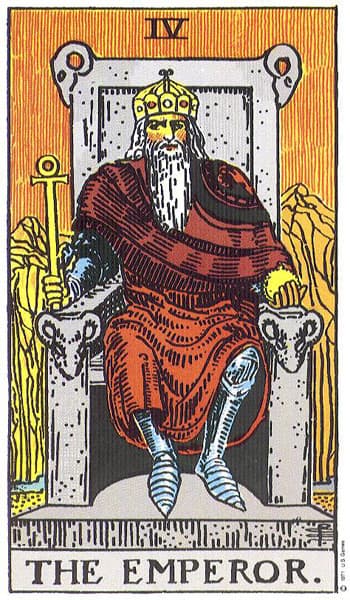
The Emperor
The Moon with The Emperor points to authority figures or structures being questioned or unclear—is someone truly as competent or trustworthy as they appear? Reversed, it suggests clarity about leadership and structure, with confusion resolving into respect or necessary boundaries.
Six of Wands
The Moon with Six of Wands indicates success or recognition that feels hollow, unearned, or based on illusion—public image masking private doubt. Reversed, true recognition emerges based on genuine accomplishment rather than appearance.
Ten of Swords
The Moon amplifies Ten of Swords' despair by suggesting the situation is worse in your mind than in reality—anxiety and catastrophic thinking compound grief. Reversed together, this shows the truth being lighter than your fears, pain becoming bearable as illusions dissolve.
Eight of Pentacles
The Moon with Eight of Pentacles suggests you're developing skill but doubting your progress or the value of your work—imposter syndrome clouds your perception of growth. Reversed, confidence in your developing expertise returns.
Eight of Cups
The Moon with Eight of Cups indicates you're uncertain whether to leave a situation—fear and confusion prevent clear discernment. Reversed, the decision becomes clear and you find the courage to move forward.
Six of Cups
The Moon with Six of Cups points to nostalgia mixed with illusion—you're remembering the past through rose-tinted or distorted glasses, potentially recreating old patterns. Reversed, you see your history clearly and learn from it authentically.
Frequently Asked Questions
Is The Moon a good card?
What does The Moon mean in a love reading?
What does The Moon reversed mean?
Does The Moon mean yes or no?
What zodiac sign is The Moon?
What does The Moon mean as feelings?
What does The Moon card mean when it keeps appearing in my readings?
Is The Moon tarot card about mental health or anxiety?
What does The Moon mean for reconciliation with an ex?
Does The Moon card mean someone is lying to me?
What does The Moon mean in a pregnancy or fertility reading?
Why is there a lobster or crayfish on The Moon tarot card?
What does The Moon reversed mean for no-contact situations?
Is The Moon a twin flame or soulmate card?
What does The Moon mean for dreams and dream interpretation?
Ask the AI About The Moon
Get a personalized AI reading and discover how The Moon connects with your unique spread.
Get a Free ReadingTarot readings are for entertainment and self-reflection only. Not a substitute for professional medical, financial, or psychological advice.