Major Arcana · 16
The Tower Tarot Card Meaning
The Tower represents sudden, transformative upheaval that breaks through illusion and forces authentic rebuilding. This fire card, governed by Mars, arrives when structures—whether beliefs, relationships, or circumstances—are no longer serving your growth. What crumbles now makes space for truth.
Upright
Reversed
↑ The Tower Upright Meaning
The Tower arrives in your reading as a profound messenger, not a punisher. When you see this card upright, you're encountering a moment when the universe—or your own deeper self—is dismantling something that has been constructed on shaky ground. This might be a belief system that no longer fits who you're becoming, a relationship dynamic built on illusion, a career path misaligned with your values, or even a self-image you've outgrown.
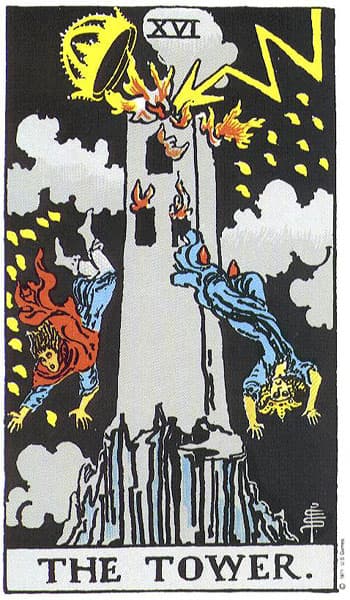
In the Rider-Waite-Smith imagery, lightning strikes a crowned tower, and figures fall from its heights. This isn't random destruction. The lightning is illumination—sudden clarity that reveals what was always fragile. The fall, while disorienting, is often necessary. You cannot build authentically without first clearing away false structures.
What makes The Tower different from other cards of challenge is its gift of revelation. Unlike slow, grinding difficulty, The Tower offers speed and clarity. Yes, it hurts. Yes, it's disorienting. But the truth it exposes is ultimately liberating. You're being invited to stop pretending, stop propping up what's already broken, and start building from honest ground.
This card invites you to consider what you've known, deep down, needed to change. Perhaps you've sensed it for months or years. The Tower doesn't create the need for change—it accelerates it. It brings suppressed truths into unavoidable visibility. A partnership that was hollow suddenly collapses. A job that drained your spirit suddenly becomes impossible to maintain. A worldview that limited you suddenly can't hold.
The spiritual significance here is one of grace disguised as catastrophe. Many people look back on their Tower moments as pivotal awakenings. What felt like ending was actually beginning. The person who emerges from Tower energy is more authentic, more aligned, more genuinely themselves than before.
Practically, when The Tower appears upright, your work is to surrender to the process rather than resist it. Fight to preserve what's crumbling, and you'll suffer more. Accept that something needs to fall away, and you move faster toward rebuilt wholeness. This is the time to be honest about what isn't working, to speak truths you've been swallowing, to allow necessary endings.
↓ The Tower Reversed Meaning
When The Tower reverses, the explosive energy doesn't disappear—it internalizes. You're experiencing the same fundamental call for change and truth, but without the swift, external catalyst. This can manifest as a slow-building anxiety that something needs to shift, a nagging sense of inauthenticity, or an internal pressure cooker building beneath a calm surface.
Reversed, The Tower often suggests you're resisting or delaying a necessary reckoning. Perhaps you're aware on some level that a situation has become unsustainable, but you're choosing stability over truth. You might be bargaining with yourself—telling yourself you can fix things without major change, or that if you just hold on a bit longer, the situation will improve. This is the energy of denial.
Alternatively, this card can indicate that the collapse has already occurred, and you're now in the rebuilding phase. The chaos has passed; now comes the slower, interior work of reconstructing your sense of self and your life. This version carries less drama but requires patience and commitment to genuine reconstruction rather than quick fixes.
The reversed Tower invites you to ask: What truth am I avoiding? What structure am I propping up that feels dishonest? The longer you delay necessary change, the more pressure builds internally. This isn't a card inviting you to avoid change—it's showing you that change deferred often becomes change enforced more harshly later.
In some readings, reversed Tower can also reflect fear of collapse. You're terrified of the tower falling, so you're white-knuckling to keep it standing. This exhaustion itself becomes the problem. The energy here suggests that allowing some controlled falling apart might be gentler than the alternative.
♥ The Tower in Love & Relationships
Upright, The Tower in love readings signals a dramatic shift or revelation that changes the relationship's trajectory. If you're single, this might be a sudden end to a connection you thought was developing, or clarity that a pattern you've been repeating needs to stop. In established relationships, The Tower often represents a truth emerging—infidelity discovered, a hidden resentment exposed, or a fundamental incompatibility suddenly undeniable. This can feel devastating, but it's also clarifying. You cannot build genuine intimacy on a false foundation.
Reversed, The Tower suggests you're sensing that something needs to change in your romantic life, but you're hesitant to acknowledge it. You might stay in a relationship that's become hollow because you fear being alone, or you might avoid having a crucial conversation because it feels easier. Single people might find themselves stuck in cycles—aware they need to change their dating patterns but feeling afraid to do so. The reversed Tower asks: What emotional truth are you protecting yourself from? What conversation are you avoiding? Sometimes this card indicates you're in the slow-rebuild phase after a relationship ended, learning to trust connection again.
◆ The Tower in Career & Finances
In career contexts, upright Tower often brings sudden job loss, a dramatic company restructuring, or an abrupt exposure of corruption or misalignment. What feels shocking is actually revealing. Perhaps you've been overlooking red flags; the Tower makes them impossible to ignore. You might lose a position, but in retrospect, it redirects you toward work more aligned with your values. Financially, this can signal sudden loss or exposure of hidden debt—again, painful but clarifying.
Reversed, The Tower in career suggests you're aware your current job or financial situation isn't sustainable, but you haven't acted on that knowing. You might feel trapped or anxious about your work but fear making a change. This card invites honest assessment: Are you staying in a position that's damaging your integrity? Are you avoiding financial truths? Sometimes reversed Tower indicates the restructuring has already happened and you're now stabilizing after the shock. The invitation is to use this clarity to build toward work that genuinely fits who you are.
✦ The Tower as Feelings
When The Tower appears as feelings, you're encountering an intensity that cannot be ignored. Upright, this card suggests the person feels a profound destabilization in relation to you or the situation—but here's the nuance: this isn't necessarily negative. They may feel their certainties being challenged, their old patterns disrupted, their comfortable assumptions shattered by your presence or by what's unfolding. There's electricity here, urgency, a sense that something fundamental is shifting. They might feel frightened by this intensity, exhilarated by it, or both simultaneously. Their emotional state is turbulent because something real is breaking through their defenses. This can manifest as passionate love that feels chaotic, or as the unsettling feeling of being genuinely seen for the first time. Reversed, The Tower as feelings suggests a suppression of these destabilizing emotions. The person may be avoiding the emotional earthquake they sense brewing. They're holding back intensity, perhaps denying how much the situation or you has affected them. There's a blocked rawness here—feelings that want to erupt but are being contained, sometimes through fear, sometimes through rationalization. This can indicate emotional numbness masking deeper turmoil, or a conscious choice to keep things surface-level precisely because acknowledging the depth would require them to face their own upheaval. In both orientations, The Tower as feelings invites you to recognize that calm, steady affection may not be what's present—what you're encountering is real, catalytic, and demanding to be acknowledged.
◇ The Tower as How Someone Sees You
Upright, The Tower positions you as a force of necessary disruption in this person's inner world. They see you as someone who challenges their status quo—perhaps you embody truths they've been avoiding, or you represent possibilities that destabilize their carefully constructed reality. You might appear to them as a catalyst, a revealer, someone who breaks through their illusions. This can be admiring—they see you as courageous, authentic, uncompromising—or it can be unsettling, depending on how ready they are for change. You may seem dangerous to their comfort, liberating to their authentic self, or both. There's a quality of intensity they associate with you, a sense that being around you or considering your presence requires them to rebuild something fundamental about how they see themselves or the world. Reversed, the perception shifts: you might be seen as either the victim of disruption or as someone whose disruptive potential is being diminished in their mind. They could perceive you as unstable, chaotic, or destructive—though this says as much about their resistance to change as it does about your actual nature. Alternatively, they may be minimizing your impact on them, reducing you to a smaller role than you actually play, perhaps to protect themselves from acknowledging how much you've shaken their foundations. They might also see you as someone who didn't follow through on transformation, who created chaos but didn't enable actual breakthrough. In both cases, this person's perception of you is tied to your relationship with change and truth.
→ The Tower Advice
The Tower upright counsels you to stop bracing against what's already crumbling. You likely sense that something needs to break—a stagnant pattern, an outgrown identity, a relationship or situation that's been held together by habit rather than authenticity. The advice here is to stop using your energy to prop up what's already destabilized. Instead, surrender to the necessary breakdown. This doesn't mean passivity; it means honest acknowledgment. What beliefs about yourself are no longer serving you? What structures have you been maintaining out of fear of the unknown? The liberating act is to stop pretending the foundation is solid when you already know it's not. Let it fall. The aftermath will reveal what was true and what was illusion. Reversed, The Tower asks you to examine where you're resisting necessary change. Are you clinging to comfort despite knowing something needs to shift? Are you minimizing a situation that demands your attention and courage? The advice invites you to identify what you're avoiding and why. Sometimes reversed guidance here also suggests the need to pace yourself—not all eruptions need to happen at once. If you're in active chaos, this card might counsel stabilization and small, intentional rebuilds rather than grand declarations. But the deeper message is: stop negotiating with what's already broken. The reversal often indicates that postponing the inevitable only extends suffering. Whether upright or reversed, The Tower as advice ultimately invites you to trust that collapse creates space for authentic reconstruction.
✧ The Symbolism, Read Closely
Look first at the sky: it is black. Not storm-gray, not twilight — an absolute black that swallows everything behind the action. Against it, the clouds are rendered in flat white, scattered around the tower like puffs of smoke or afterthoughts. This is worth sitting with. Pamela Colman Smith did not paint a weather event; she painted a void with a single fact standing in it.
The tower itself is gray, narrow, and absurdly tall for its base, perched on a jagged gray mountain peak with no visible path up or down. It has no door at all, only small windows — this is a structure built for isolation, not for living. At its summit sits a gold crown, and the lightning has knocked it clean off. The crown is the detail readers return to again and again: the tower is topped not by a roof but by an idea of rule, of being the highest thing around. The bolt does not strike the walls first. It decapitates the claim.
The lightning itself is drawn as a sharp, jagged yellow arrow descending from the upper right, and flame blooms orange from the tower's three windows. Scattered through the black air are twenty-two small yellow flame-shapes — twelve falling along the left side, ten along the right — often read as yods, the spark-form of the Hebrew alphabet, the seed of divine speech raining down even as everything burns. Destruction and alphabet in the same sky: the letter-shapes suggest that what falls here is not rubble but meaning, a new vocabulary arriving in pieces.
Then the two figures. On the left, a figure in a red cloak over blue, wearing a crown, falls headfirst, arms out, face turned toward us. On the right, a figure in flowing blue robes dives in the same headlong posture. One crowned, one not — frequently read as the conscious ruler and the feeling self, or simply: nobody gets to keep their footing here. Their falls mirror each other across the tower's spine, symmetrical, almost graceful. Smith drew them mid-air, not crumpled at the base. The card holds the fall open, suspended — it refuses to show you the landing, because the landing is the part you get to write.
At the bottom right edge sits the small printed signature and the title, plain as a label. The whole image has the flatness of a woodcut — no depth, no escape route, only the event itself, framed like a fact.
✧ What This Card Is Not
The first and most stubborn misreading is that The Tower predicts a catastrophe coming for you — a literal accident, a disaster on a specific date, doom with a timestamp. Pop culture treats this card as the deck's jump scare, the moment the reader inhales sharply and the music swells. But look at what is actually on the card: an event, already in motion, rendered without aftermath. The card is not a forecast. It is a recognition. Readers often find it appears not before something falls apart, but in the very season of falling — it names what is happening, which is a profoundly different act than predicting it.
The second distortion is that The Tower is purely punitive — that you did something wrong and now comes punishment. The imagery argues against this. The tower falls because of how it was built: too tall for its foundation, crowned with its own importance, sealed against the sky. The lightning is not moral judgment; it is physics catching up with architecture. The card is not saying you deserve this. It is asking what was built on an unexamined base.
Third: the idea that The Tower's destruction is total and permanent, an ending with nothing after. Yet the figures are mid-fall, the ground is out of frame, and the twenty-two falling sparks suggest seeds, not ash. The card conspicuously withholds the wreckage.
Finally, the subtler misreading: that The Tower only describes big, cinematic events — divorce, firing, diagnosis. In practice it just as often marks the quiet internal instant when a story you've been telling yourself stops working, and nothing external has visibly changed at all. The loudest card in the deck frequently describes the most private moment in it.
✧ Sitting With the Harder Side
It would be dishonest to write about The Tower without acknowledging that sometimes this card arrives when you are genuinely not okay. Not poetically unsettled — actually frightened, actually grieving, actually standing in a life whose floor just dropped. If that is where you are, the last thing you need is a card meaning dressed up as a blessing.
So here is the harder truth the card carries: the falling part is real, and it is not ennobling while it is happening. The Tower does not ask you to be grateful for the collapse. It does not ask you to reframe, to find the lesson, to perform resilience for anyone — including yourself. The figures on the card are not meditating on their growth. They are falling, crowned and uncrowned alike, and the card honors that by freezing them there rather than tidying them up.
What the imagery quietly offers is one small, sturdy observation: the tower that fell was the sealed one. The structure with one door, perched alone on a peak, built upward past the point its foundation could hold. Whatever is breaking in your life right now, it is worth gently asking — not today, not while it still hurts, but eventually — whether the thing that fell was ever built to hold the real you, or only the version of you that kept everything contained.
There is also the matter of the ground. You cannot see it on the card, and right now you may not be able to feel it either. But the figures are falling toward something. The card's black sky is not the whole picture; it is only the part you can currently see. You do not have to build anything yet. You are allowed to just be mid-air for a while.
✧ What It Looks Like in a Real Reading
Mara has been offered a promotion — more money, a better title — at a company where, eight months ago, a reorganization quietly moved her entire team under a manager she doesn't trust. She's been telling herself she can make it work. She pulls The Tower and laughs, because it's almost rude in its directness. The question she wrote down was 'Should I take the offer?' but the card seems to answer a different one: the structure she's negotiating her place inside is already cracked. She doesn't decide anything that night. But she stops drafting the acceptance email, and notices, for the first time, that her body had been bracing for months.
Devon asked about a friendship — someone who hasn't answered his last three messages, after a year of Devon doing most of the reaching. The Tower lands and his first reaction is fear: is the friendship over? Sitting with the image longer, what surfaces is stranger and calmer. The tower that falls in the card was already hollow; Devon realizes he isn't mourning the friendship as it actually was, but as he'd been maintaining it in his head. The unanswered texts didn't destroy anything. They just stopped propping it up.
Priya pulls The Tower the week before a long-awaited medical follow-up, and her stomach drops. In the reading, though, the card keeps pointing somewhere unexpected: not at the results, which no card can know, but at the story she'd built while waiting — the catastrophizing tower, furnished floor by floor over three sleepless weeks. What she takes from it is permission to let that structure fall early, before the appointment does or doesn't. She sleeps that night. The real news, whatever it turns out to be, she decides to meet on honest ground rather than from the top of an imagined worst case.
✧ How Other Decks See This Card
In the Tarot de Marseille tradition, this card carries a name far stranger than The Tower: La Maison Dieu — The House of God, or as it is sometimes rendered, The Hospital. The image differs from the Rider-Waite-Smith in telling ways. The Marseille tower is struck at the crown by what reads as a ray or burst from above, its top shearing off, with two figures tumbling below — but the colored droplets falling around them have long been read not as flames but as gifts, manna, or coins: something raining down from heaven even as the building fails. The older name reframes the entire event. This is not merely a destroyed structure; it is a house of God undergoing correction, and what falls from the sky is nourishment as much as ruin.
Pamela Colman Smith's 1909 design kept the struck crown and the falling pair but darkened everything: the Marseille's daylight becomes a black void, the droplets become flame-shaped yods, and the scene gains its now-iconic single bolt of lightning. Where the Marseille image feels almost matter-of-fact — a tower, struck, as towers are — the Rider-Waite-Smith version is theatrical, apocalyptic, and psychological. The emphasis shifts from correction to revelation.
In the Thoth deck, Aleister Crowley and Lady Frieda Harris renamed the card The Blasted Tower and assigned it to the Hebrew letter Peh, meaning 'mouth,' and to Mars. Harris painted the tower as a fortress being demolished by fire and a blasting force, with an eye watching from above and a dove-like figure of light near the destruction. The Mars attribution, which the Rider-Waite-Smith tradition also holds, frames the card as martial energy: sudden, forceful, purgative. The 'mouth' association adds a striking layer — the tower falls by and for speech, the truth spoken that brings false structures down.
Across all three lineages the core is stable — a proud structure, struck from above, its occupants thrown — but the emphasis travels: divine correction, revelatory collapse, or purifying force. Which tower you pull depends on which deck's philosophy you read through.
? The Tower: Yes or No?
The Tower's yes-or-no answer depends on what you're asking. If you're asking whether something needs to change, the answer is yes—emphatically. If you're asking whether a situation will remain stable, the answer is no. If you're asking whether a specific outcome you're hoping for will happen, the Tower often indicates upheaval will prevent that exact outcome, forcing a different path. The card suggests that whatever happens next will be disruptive but ultimately clarifying. Trust the process even when it's uncomfortable.
Common Card Combinations
The Fool
The Fool + The Tower suggests you're being pushed into a leap of faith by circumstances beyond your control. A sudden upheaval becomes your initiatory experience, forcing you to trust the unknown.
Page of Swords
Page of Swords + The Tower indicates a truth or revelation coming through communication or inquiry. Someone's honest words or unexpected news triggers the necessary collapse.
Five of Cups
Five of Cups + The Tower suggests grief and loss following upheaval. After the lightning strike comes the mourning period—both cards emphasize necessary emotional processing.
Queen of Swords
Queen of Swords + The Tower indicates clear-eyed truth-telling in the midst of chaos. A wise, articulate voice cuts through the confusion and names what's really happening.
Two of Wands
Two of Wands + The Tower shows your plans being disrupted by unexpected change. What you intended to build must be reconsidered in light of new circumstances.
Three of Cups
Three of Cups + The Tower suggests that after upheaval, community and connection become essential for recovery. The collapse brings people together in shared support.
Seven of Wands
Seven of Wands + The Tower indicates you're defending something that's already crumbling. The energy here suggests releasing the fight might be wiser than standing your ground.
Frequently Asked Questions
Is The Tower a good card?
What does The Tower mean in a love reading?
What does The Tower reversed mean?
Does The Tower mean yes or no?
What does The Tower mean as a feelings card?
Is The Tower associated with a zodiac sign?
What does The Tower mean when it shows up out of nowhere in a daily pull?
Why am I scared of The Tower card?
What does The Tower mean after a breakup?
What does The Tower mean as an obstacle?
What tarot card comes after The Tower and why does it matter?
What does The Tower mean for someone new — a new relationship or new job?
Is The Tower about mental health or anxiety?
What does The Tower mean in the past position?
Can The Tower be a positive card in a reading?
Ask the AI About The Tower
Get a personalized AI reading and discover how The Tower connects with your unique spread.
Get a Free ReadingTarot readings are for entertainment and self-reflection only. Not a substitute for professional medical, financial, or psychological advice.