Minor Arcana · Suit of Swords
Three of Swords Tarot Card Meaning
The Three of Swords depicts heartbreak and mental anguish—a moment when painful truth pierces through denial. This card invites you to acknowledge difficult emotions rather than suppress them, recognizing that conscious grief is the pathway to healing and clarity.
Upright
Reversed
↑ Three of Swords Upright Meaning
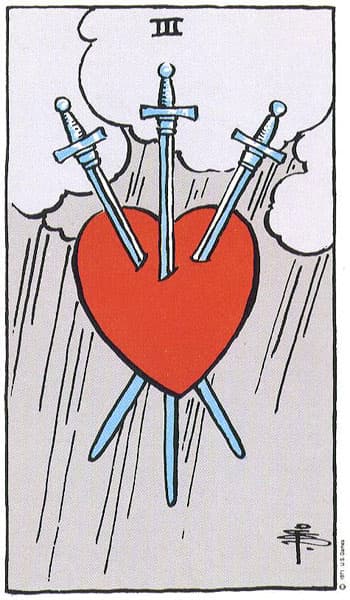
The Three of Swords shows three blades piercing a heart beneath stormy skies—a stark visual of how mental clarity can feel like emotional devastation. In the Rider-Waite-Smith imagery, the grey cloudscape suggests this is a temporary weather system, not permanent darkness, though it doesn't feel that way in the moment.
When this card appears upright, you're likely confronting a truth you've been avoiding. This might be recognizing incompatibility in a relationship, acknowledging a workplace dynamic that isn't serving you, or accepting circumstances you cannot control. The Three of Swords isn't about creating drama; it's about the sorrow that arrives when you stop lying to yourself.
The elemental nature of Swords—Air, mind, communication—means this suffering is often rooted in thought patterns and honest dialogue. The pain here is real, but it's also purposeful. By facing what hurts, you gain clarity that denial never provided. This card often appears when you're moving from confusion to understanding, even if understanding brings tears.
Spiritual significance: This card teaches that not all pain should be spiritually bypassed or "transcended." Grief is intelligence. It signals that something meaningful has ended or shifted. The invitation isn't to suffer indefinitely, but to honor the weight of what you've lost or learned, moving through sorrow rather than around it.
Practically, this card suggests being honest in conversations you've been delaying. If a relationship is ending, a Three of Swords moment is when you finally speak the unspeakable. If a project is failing, this is when you admit it and adjust course. The storm here clears the air—difficult, yes, but necessary.
↓ Three of Swords Reversed Meaning
Reversed, the Three of Swords shifts from acute pain to gradual healing. The storm isn't directly overhead anymore; it's moving toward the horizon. This doesn't mean your suffering disappears instantly, but rather that you're moving through it, integrating it, releasing it.
This card reversed often indicates you're ready to forgive—yourself or someone else. Perhaps you've spent time in the sorrow of the upright position and now find yourself ready to soften, to see the humanity in the situation, to stop rehearsing the story of what went wrong.
Communication begins to improve. If the upright Three of Swords was the harsh truth spoken aloud, reversed is when dialogue becomes possible again. Misunderstandings clarify. Apologies are offered and received. The defensiveness that accompanied acute pain begins to relax.
There's also a shadow aspect to consider: reversed, this card can indicate emotional numbness or avoidance. You might be suppressing legitimate pain too quickly, moving past grief before you've truly felt it. The invitation isn't to skip the healing process, but to move through it authentically, at your own pace.
Spiritual meaning here is about integration—taking the lessons that pain taught you and weaving them into wisdom. This is post-crisis clarity, where you understand how the difficulty changed you, hopefully for the better. You're not back to before the pain; you're wiser because of it.
♥ Three of Swords in Love & Relationships
Upright, the Three of Swords often appears when a relationship reaches a breaking point or truth surfaces that cannot be ignored. If you're single, this card can indicate heartbreak you're still processing—the end of something you believed in. In partnerships, it frequently signals a conversation that needs to happen: about incompatibility, betrayal, neglect, or misalignment. This isn't necessarily about separation; sometimes the pain of honesty leads to deeper intimacy and renegotiation. The card invites you to speak what you've been afraid to voice.
Reversed, healing is underway. If you've recently experienced a breakup, this card suggests you're moving through shock into acceptance. In existing relationships, it can indicate that a difficult conversation has occurred and you're both choosing to understand each other more deeply. Forgiveness becomes possible. Resentment softens. The reversed Three of Swords in love readings often appears when couples recommit after crisis, or when individuals release bitterness about past relationships.
For singles, reversed suggests you're ready to open your heart again after heartbreak, having learned what you needed to learn. You're not naïve or desperate to avoid pain again; you're simply ready to trust again, carrying your wisdom forward.
◆ Three of Swords in Career & Finances
Upright, the Three of Swords often indicates a workplace truth-telling moment. A project that isn't working gets named. Incompatibility with a boss or colleague becomes unavoidable. You might receive critical feedback that stings, or realize a career path isn't aligned with your values. Financially, this card can signal loss—market corrections, unexpected expenses, or the pain of admitting overspending. The card invites honest assessment rather than avoidance.
Reversed, career recovery begins. A difficult conversation with management leads to better working conditions. Financial pressure eases as you implement changes. This card often appears when you're moving past workplace conflict toward better collaboration. If you've been in a toxic job, reversed suggests you're ready to leave or you've found ways to make it functional again. Financially, it can indicate recovery, better money management, or decisions that ease burden.
In both positions, the Three of Swords asks: What truth are you avoiding in your work or finances? What conversation would ease the pressure? This card rewards honesty, even when honesty is uncomfortable.
✦ Three of Swords as Feelings
When Three of Swords appears as someone's feelings toward you, you're encountering an emotional landscape marked by conflict, doubt, or painful clarity. Upright, this card suggests they're experiencing genuine distress in relation to you or the situation—perhaps they see incompatibility you've both been denying, or they're wrestling with a difficult truth about the dynamic between you. Their feelings aren't apathetic; they're intensely present and troubling. This might manifest as confusion mixed with sorrow, or as the kind of mental anguish that comes from knowing something needs to change but dreading the consequences. They may feel torn between what they want and what they recognize as reality. Reversed, Three of Swords can indicate their emotional turbulence is beginning to settle. The acute pain is softening into acceptance or moving toward resolution. They might be releasing feelings they've held—whether that's anger, guilt, or grief—and finding a quieter, if still tender, place with those emotions. Reversed, they're also less likely to be in crisis mode; they're processing rather than spiraling. In both positions, this card reveals someone deeply feeling, not distant. The difference is whether they're actively in the storm or beginning to see light breaking through the clouds.
◇ Three of Swords as How Someone Sees You
Three of Swords in a 'how someone sees you' position reveals they perceive you as central to a painful situation or difficult truth. Upright, they may see you as the source of clarity—sometimes unwelcome clarity—in their life. You're the person or situation forcing them to confront something they'd prefer to avoid. This doesn't necessarily mean they blame you; rather, your presence or the dynamics you share have illuminated something that hurts. They might see you as someone navigating difficulty with you, or as the embodiment of a hard choice they're facing. You could represent necessary endings, growth through discomfort, or honest communication even when it stings. Reversed, their perception shifts toward seeing you as moving through pain rather than causing it. They recognize your own struggle and may feel compassion for your situation. Reversed, you're less likely to be viewed as the catalyst and more as a fellow traveler in difficulty. They see your vulnerability, your capacity to face hard truths, or your willingness to release what isn't working. In both positions, this card positions you as someone significant to their emotional life—not peripheral or easily dismissed. The reversal suggests they're finding softer ground in how they regard you, even if the underlying situation remains complex.
→ Three of Swords Advice
Three of Swords upright counsels you to stop negotiating with painful truth. This card invites you to consider what you've been avoiding naming—in a relationship, situation, or within yourself. The advice here isn't to be reckless or cruel, but to honor reality as it actually is, not as you wish it to be. Sometimes clarity hurts precisely because it's accurate. Ask yourself: What am I not saying? What do I already know but haven't admitted? The card suggests that moving through this pain, rather than around it, is what actually leads to relief. You might need to have a difficult conversation, set a boundary you've resisted, or acknowledge that something isn't sustainable. The stormy skies in this card are temporary; naming the truth is what clears the air. Reversed, Three of Swords advises you to release what you've already processed. If you've moved through recognition of a painful truth, don't circle back into rumination. Reversed, this card suggests forgiveness—of others or yourself—and the wisdom to know when continued examination becomes self-harm rather than growth. It encourages you to grieve what needs grieving and then gently redirect your energy toward what's next. In both positions, the card asks you to trust that emotional release, however uncomfortable, creates space for genuine healing.
✧ Sitting With the Harder Side
There is a particular loneliness to the Three of Swords that other difficult cards don't quite carry. The Tower arrives with spectacle, the Ten of Swords with finality, but this one is quieter — a private ache that often goes unseen by everyone around you. If you've pulled this card while something in your life is genuinely hurting, the first thing worth saying is that the card doesn't ask you to be graceful about it.
The harder territory here is the way mental pain loops. Unlike a broken bone, heartache replays itself. You rehearse the conversation. You reread the message. You wake at three in the morning with the sentence you should have said fully formed in your mouth. The suit of Swords governs thought, and the shadow of this card is thought turned against itself — the same few facts rotated endlessly, as if examining the wound one more time might make it make sense.
There is also the temptation toward performance. Some people respond to this card's energy by broadcasting their pain to anyone who will listen; others bury it so efficiently that even they believe it isn't there. Neither is wrong, exactly. Both are ways of trying to manage something that feels unmanageable. The card simply notices the strategy.
What this card quietly suggests, if you're in it now, is that sorrow has its own timeline and doesn't respond well to being rushed or argued with. You don't have to find the lesson yet. You don't have to forgive anyone yet. The heart on this card is pierced, yes — but it is also, noticeably, still whole in shape. It has not shattered. Something in you is holding its form even while it hurts. That is not nothing. Many readers find that the most honest response to this card is the simplest one: admitting, out loud if possible, that this actually hurts.
✧ The Symbolism, Read Closely
Pamela Colman Smith's 1909 design for this card is one of the starkest in the entire Rider-Waite-Smith deck, and its power comes from what she left out. There are no human figures. No landscape, no architecture, no narrative scene — just a heart, three swords, rain, and cloud. Where almost every other card in the deck gives you a person to identify with, this one gives you an organ. The implication is uncomfortable and deliberate: this is pain before anyone has wrapped a story around it.
The heart itself is rendered in a flat, saturated red, drawn as a perfect symmetrical valentine shape rather than anything anatomical. It floats in the center of the card, held in place by nothing. That floating quality matters — the heart is unmoored, unsupported, suspended in grey air with no ground beneath it. Pain of this kind has no footing.
Three swords pass completely through the heart. Look closely at their arrangement: one blade drives straight down through the center from above, exiting at the bottom point, while the other two enter diagonally from the upper left and upper right, crossing behind the heart so their tips emerge below on either side. The two angled swords appear to enter from the cloud mass above, as if the blows came from the sky — from circumstance, from things said by others, from truths that arrived rather than truths you chose. Their hilts, with rounded pommels and simple crossguards, sit at three different heights, giving the composition an uneasy asymmetry despite the heart's perfect symmetry. Three wounds, not one. Readers have long noted that the pain this card describes rarely has a single source.
Above and behind everything sits a heavy bank of grey cloud, drawn in thick outlines with scalloped edges, occupying most of the upper half of the card. From it, slanting lines of rain fall across the entire scene — behind the swords, behind the heart, covering every corner. Nothing on the card escapes the rain. There is no shelter, no patch of clear sky visible anywhere. Yet the clouds are drawn as a single bank rather than a black sky; grey, not darkness. Smith chose weather, not night. Weather passes.
The Roman numeral III sits centered at the top, the only text. And in the lower right corner, small and easy to miss, is Smith's own signature mark — her monogram, crossed like a tiny sword itself. Even the artist's name on this card takes the shape of a blade. The whole composition is an argument: grief is weather, the heart endures, and the swords — for all their violence — are the only straight, clean lines in the image. Truth, however much it wounds, is the one thing here that is not blurred.
✧ What It Looks Like in a Real Reading
Mara pulls the Three of Swords after asking about a job offer she's been sitting on for a week. On paper it's everything she wanted — better title, better pay. But taking it means leaving a team she loves, and more than that, it means admitting out loud that her current boss's promises of promotion were never going to materialize. The card lands less like a warning about the new job and more like a mirror held up to the old one. Her hesitation, she realizes, isn't about the offer. It's grief. She'd been loyal to a version of her workplace that stopped existing two years ago, and accepting the offer means finally saying so. The card doesn't tell her what to choose. It tells her why the choosing hurts.
Devon asks about a friend who hasn't answered his messages in three weeks. Not a fight — just silence, slow and total. He pulls the Three of Swords and immediately wants to pull another card over it, which is itself informative. Sitting with it, he admits what the silence has been telling him: the friendship has been one-directional for a long time, and part of him has known. The unanswered texts didn't create the wound; they only made it impossible to keep explaining away. The card invites him to grieve the friendship as it actually was, rather than keep composing messages to the version he wished for. What he does with that — reaching out once more, or letting it rest — stays his.
Priya draws it while waiting on test results, asking simply how to get through the week. She isn't asking for a prediction and the card doesn't offer one. Instead it names what's already happening: her mind is running every outcome on a loop, and the dread itself has become a second illness. The card's honesty comforts her strangely — it treats her fear as real rather than as something to positive-think away. She decides that what she needs this week isn't answers she can't get yet, but company: dinners with her sister, her phone handed to someone else at night. The card gave her permission to stop pretending she was fine.
✧ What This Card Is Not
The most common distortion is treating the Three of Swords as a prediction of betrayal — pulling it and immediately concluding that a partner is cheating or a friend is about to turn on you. Pop culture has flattened this card into a cheating alarm, largely because the image is so easy to dramatize. But the card depicts pain and piercing truth, not infidelity specifically. It appears just as often for grief that has nothing to do with anyone's wrongdoing: a dream deferred, a diagnosis in the family, the quiet recognition that something you hoped for isn't coming. Reading it as you will be betrayed both overstates the card and misses what it's actually doing — asking what you already know and haven't admitted.
A second misreading is assuming it always signals an ending. People pull it in a relationship reading and start emotionally packing boxes. In practice, the card frequently marks a conversation, not a conclusion — the moment a buried truth finally gets spoken, which often becomes the turning point a relationship survives rather than dies from. Truth wounds and truth clears; the card holds both.
Third, there's the inverse error: dismissing it as just anxiety, catastrophizing, a card about thoughts rather than real events. Because Swords is the suit of mind, some readers wave it off as worry and nothing more. This undersells it. The pain this card points at is usually attached to something real — the mental anguish is the processing, not the problem.
Finally, the card is not a command to suffer nobly or to harvest the lesson immediately. The contemporary gloss — pain is a teacher, everything happens for a reason — can become a way of skipping the grief entirely. The heart on this card is pierced and it is raining. The card's first instruction is simply to let that be true for a while. Meaning-making comes later, on its own schedule, and it isn't owed to anyone.
? Three of Swords: Yes or No?
The answer is contextual. Upright, if you're asking whether you should have a difficult conversation or face a hard truth, the answer leans toward yes—you need this clarity, even if it hurts. If you're asking whether a situation will resolve easily, the answer is no. Reversed shifts toward a cautious yes, particularly if you're asking whether healing or improvement is possible. The card suggests that pain is present or recent, but not permanent.
Common Card Combinations
Justice
Justice with the Three of Swords indicates that painful truths are being revealed for a reason—accountability and fairness are coming. Someone will answer for their actions, or you'll finally see a situation clearly and fairly after emotional confusion.
The Empress
This pairing suggests heartbreak in a nurturing context—perhaps grief over losing a creative project, fertility struggles, or a relationship that felt like home. It can also indicate healing through self-compassion and self-nurturing after pain.
Four of Cups
Emotional withdrawal following heartbreak or painful revelation. You're in apathy or protective isolation after a wound. This combination suggests needing space to process before you're ready to receive anything new.
King of Swords
Intellectual honesty cuts through emotional denial. The King of Swords with Three of Swords indicates someone using clear logic to acknowledge painful reality, or difficult truths being spoken by an authority figure with precision.
Two of Cups
Two of Cups with Three of Swords suggests relationship pain that leads to deeper intimacy or difficult conversation that ultimately strengthens connection. Paradoxically, acknowledged heartbreak can deepen emotional bonds.
Five of Cups
Both cards of sorrow and loss combined—this intensifies emotional difficulty. However, Five of Cups always includes an unseen figure turning away from the cups, suggesting this combination moves toward acceptance and the possibility of moving forward.
Temperance
Temperance with Three of Swords indicates that balance and moderation will emerge from pain. This combination suggests patience with grief, integrating the lesson without remaining stuck in it, finding equilibrium after disruption.
Frequently Asked Questions
Is Three of Swords a good card?
What does Three of Swords mean in a love reading?
What does Three of Swords mean as feelings?
Is Three of Swords a yes or no?
What zodiac sign is Three of Swords?
Does Three of Swords always mean bad news?
Does the Three of Swords mean someone is cheating on me?
What does the Three of Swords mean when it's about my ex?
Is the Three of Swords a bad card to get for a relationship?
Why does the Three of Swords keep showing up in my readings?
What does the Three of Swords mean for reconciliation?
Does the Three of Swords mean my relationship is over?
What does the Three of Swords mean in the future position?
Can the Three of Swords be a positive card?
How long does the energy of the Three of Swords last?
Ask the AI About Three of Swords
Get a personalized AI reading and discover how Three of Swords connects with your unique spread.
Get a Free ReadingTarot readings are for entertainment and self-reflection only. Not a substitute for professional medical, financial, or psychological advice.